



Diese Seite wird nicht mehr aktualisiert. Bitte besuchen Sie unsere neue Webpräsenz.
This page is not updated any longer. Please visit our new website.
 oct_matgen is a small software libraries to generate example and benchmark matrices. The matrices are generated with the help of GNU Octave script and become availble in C or Fortran easily.
 Version 2025.2.0 of pyMOR has been released. More information at pymor.org.
 Peter Benner was elected as a member by the General Assembly of acatech, the German Academy of Science and Engineering, in October 2025.The SLICOT Team is pleased to announce the release of SLICOT Version 5.9.1, an update to the Subroutine Library in Control Theory. Significant changes include the transition of maintenance responsibilities to Martin Köhler and Jens Saak from the CSC group as the new maintainers, while expressing deep gratitude to former maintainers Vasile Sima and Andreas Varga for decades of invaluable work maintaining the software. The build system has been modernized through a complete migration to CMake, improving cross-platform compatibility and development workflows. Pre-built packages are now available for Ubuntu/Debian distributions, while packaging support has been enhanced for Fedora/RHEL-based systems. Looking ahead, ongoing efforts will focus on code modernization to align with contemporary programming standards. The source code, documentation, and resources can be accessed through the official SLICOT reference repository at GitHub: [https://github.com/SLICOT/SLICOT-Reference](https://github.com/SLICOT/SLICOT-Reference). SLICOT continues to provide robust numerical routines for control theory applications and welcomes community engagement.
 FlexiBLAS, the exchange and abstraction layer for BLAS and LAPACK with runtime backend selection, has reached version 3.5.0. This release delivers two headline features: native support for LAPACKE, the C interface to LAPACK, and support for Windows.
With LAPACKE support, C/C++ applications using the LAPACKE API can route calls through FlexiBLAS to different BLAS/LAPACK backends—such as OpenBLAS, BLIS, or oneMKL—without recompilation or code changes. The new Windows support enables consistent use and runtime switching of backends on Windows systems, simplifying cross-platform development, testing, and reproducible workflows.
Beyond these highlights, version 3.5.0 includes minor improvements and bug fixes.
FlexiBLAS, the exchange and abstraction layer for BLAS and LAPACK with runtime backend selection, has reached version 3.5.0. This release delivers two headline features: native support for LAPACKE, the C interface to LAPACK, and support for Windows.
With LAPACKE support, C/C++ applications using the LAPACKE API can route calls through FlexiBLAS to different BLAS/LAPACK backends—such as OpenBLAS, BLIS, or oneMKL—without recompilation or code changes. The new Windows support enables consistent use and runtime switching of backends on Windows systems, simplifying cross-platform development, testing, and reproducible workflows.
Beyond these highlights, version 3.5.0 includes minor improvements and bug fixes. At its workshop this year, the Expert Committee 2.13 "Modeling, Identification and Simulation in Automation Technology" of the VDI/VDE Society for Measurement and Automation Technology re-elected Dr. Jens Saak as its head. Moreover apl. Prof. Dr. Jörg Fehr (Uni Stuttgart) was elected as co-head. They will lead the expert committee together for the upcoming three years.Version 2025.1.2 of pyMOR has been released. More information at pymor.org.Version 2025.1.1 of pyMOR has been released. More information at pymor.org.
 The international association for Applied Mathematics and Mechanics set up a new activity group on research software engineering and research data management in mathematics and mechanics at this year's general assembly. This was in response to a proposal by Jens Saak (CSC), Robert Speck (FZ Jülich) and Jan Philipp Thiele (TU Braunschweig). The constituent workshop is planned for the end of the year. Exact dates are currently being determined in a survey among the founding members.
 Version 3.1 of the M-M.E.S.S. toolbox for MATLAB and GNU Octave has been released. It contains various corrections and usability improvements..
 Congratulations to Harshit Kapadia for being selected to receive an SIAM Student Travel Award to present his research on "Data-Driven Manifold Learning for Efficient Reduced-Order Modeling" at the 2025 SIAM Conference on Computational Science and Engineering (SIAM CSE) to be held March 3-7, 2025 in Forth Worth, USA.
 This year, more than 20 university students from across Ukraine participated in the competition for the ICMU Student Research Award. The following works received distinction from the Selection Committee:
Viktor Chuiko for the article "Adomian Decomposition Method in the Theory of Nonlinear Periodic Boundary Value Problems with Delay," published in the proceedings of the 20th International Scientific Congress "Dynamical System Modeling and Stability Investigation" (co-authored with Sergey Chuiko and Peter Benner). Viktor is a student of the Faculty of Mechanics and Mathematics at Taras Shevchenko National University of Kyiv.
This year, more than 20 university students from across Ukraine participated in the competition for the ICMU Student Research Award. The following works received distinction from the Selection Committee:
Viktor Chuiko for the article "Adomian Decomposition Method in the Theory of Nonlinear Periodic Boundary Value Problems with Delay," published in the proceedings of the 20th International Scientific Congress "Dynamical System Modeling and Stability Investigation" (co-authored with Sergey Chuiko and Peter Benner). Viktor is a student of the Faculty of Mechanics and Mathematics at Taras Shevchenko National University of Kyiv. The new FlexiBLAS release 3.4.5 addresses numerous minor bugs and introduces support for the latest BLAS functions, xGEMMTR. Additionally, the build process now detects the NVPL BLAS library.Version 2024.2.0 of pyMOR has been released. More information at pymor.org.
 With the publication of the textbook “Modellreduktion. Eine systemtheoretisch orientierte Einführung” in the Springer Studium Mathematik (Master) series, the first textbook in the history of the Max Planck Institute for Dynamics of Complex Technical Systems was released in 2024. The focus of the book is on systems theoretical methods, the development of which forms the essential core of the MPI's engineering research work and is applied here in the field of model reduction of dynamic systems.
 Many breakthroughs are needed in the discovery of new materials, especially for sustainable economic development based on renewable energy and carbon-neutral industrial circular processes. The BiGmax research network has investigated how data-driven approaches can be used for such breakthroughs and points out future paths in a roadmap.The annual workshop of the actvity groups "Modelling, identification and simulation in automation technology" as well as "systems and control theory" is taking place at Hotel Momentum in Anif near Salzburg again this year.
 With the second "MaRDI (Mathematical Research Data Initiative within the National Research Data Infrastructure of Germany) Workshop on Scientific Computing", we aim to bring together researchers from the Scientific Computing community and related disciplines, who are interested in the FAIRness of their research data. Apart from presentations on the current MaRDI projects and selected keynote talks, we will leave generous room for discussions. Further, we invite participants to contribute talks related to the following topics: Knowledge graphs and ontologies; Research Software (Engineering/Interfaces/Management); Benchmarks; Formal workflow descriptions; Reproduction of numerical experiments; Research data management.Version 2024.1.1 of pyMOR has been released. More information at pymor.org.
 The MaRDI Benchmark team is looking for a full-time or part-time RSE.Version 2024.1.0 of pyMOR has been released. More information at pymor.org.This year's pyMOR School will be held at Uni Münster from Monday 26h till Friday 30th of August.Our internal group retreat will take place at the MPI during July 04-05. The motivation of the group retreat is to discuss some research questions that remained unsolved for ourselves till now. Everyone is expected to give a talk, to describe the problem, and to lay the specific questions to be answered or discussed.
 The members of Review Board 3.31. "Mathematics" elected Prof. Dr. Peter Benner, Director and Head of the Computational Methods in Systems and Control Theory department, as their spokesperson at their constituent meeting in June 2024.The new FlexiBLAS release 3.4.4 improves the support for the Intel One API compilers and includes numerous fixes to support the Link-Time-Optimization features of modern compilers.
 We are organizing the GAMM Annual Meeting 2024 in Magdeburg in cooperation with our colleagues from the Faculties of Mathematics and Mechanical Engineering.The new FlexiBLAS release 3.4.2 improves the support for the upcoming GNU GCC 14 compilers.
 The Chinese mathematician and systems science expert Dr. Kang-Li Xu is conducting research at the Max Planck Institute for Dynamics of Complex Technical Systems Magdeburg for one year supported by an Alexander von Humboldt Fellowship. She is a visiting research fellow in the research group Computational Methods in Systems and Control Theory, where she is devoting herself to her special field of Riemannian optimization.
 Version 1.1.1 of our MEPACK library is released. Now, we provide support for Windows including MATLAB.Version 3.4.1 of our FlexiBLAS library is released. The new version provides support for LAPACK 3.12.0Version 2023.2.0 of pyMOR has been released. More information at pymor.org.
 Dr. rer. nat. Sridhar Chellappa, 31, scientist in the CSC department, was named the best Doctoral Student 2023 of the Faculty of Mathematics at Otto von Guericke University Magdeburg for his outstanding Ph.D. thesis. His dissertation deals with the model order reduction of dynamical systems, an increasingly important field of applied mathematics at the interface with the engineering sciences.With pyMEPACK you can use our MEPACK library directly from Python. It uses the well-known NumPy and SciPy interfaces, so it interoperates perfectly with existing Python projects.Our FlexiBLAS library is available in the FreeBSD Ports Collections. In this way it can be easily installed just like any other software. Beside the Fedora/Redhat Linux OS-family, we are now aviable in the BSD world as well.The annual workshop of the actvity groups "Modelling, identification and simulation in automation technology" as well as "systems and control theory" is taking place at Hotel Momentum in Anif near Salzburg again this year.
 MORLAB - Model Order Reduction LABoratory version 6.0 for model reduction of linear systems has been released. More information at: http://www.mpi-magdeburg.mpg.de/projects/morlab
 The first f(A)bulous Workshop on Matrix Functions and Exponential Integrators will be held at MPI Magdeburg from Monday, September 25 to Friday, September 27, 2023.Version 3.0 of the M-M.E.S.S. toolbox for MATLAB and GNU Octave has been released. It introduces Krylov subspace projection solvers for Lypaunov and Riccati equations, the first Sylvester equation solver and a new logging tool..MEPACK is a FORTRAN software library for the solution of dense Sylvester-like matrix equations. The current release supports Hessenberg and Hessenberg-Triangular matrices as inputs and contains numerous bugfixes.This year's pyMOR School will be held at TU Berlin from Monday 18th till Friday 22nd of September.Shaimaa Monem Abdelhafez winning First Place in the ACM SIGGRAPH 2023 Student Poster Competition for graduate work! Her submission "Improved Projective Dynamics Global Solves Using Snapshots-based Reduced Basis" was impressive in its execution and showed impressive benefits over existing physics-based simulation approaches. The conference is the most important conference in the field of computer graphics, with about 20,000 participants.Version 2023.1.0 of pyMOR has been released. More information at pymor.org.Our internal group retreat will take place at the MPI during July 04-05. The motivation of the group retreat is to discuss some research questions that remained unsolved for ourselves till now. Everyone is expected to give a talk, to describe the problem, and to lay the specific questions to be answered or discussed.Version 1.3 of the UF Matrix Collection Access Library has been released. Highlights:
1. Matrices may be loaded using other data types, e.g. uint16_t for the indices and float for the values.
2. The cache directory is now relocatable, without triggering a re-download of the matrices upon next use.Version 2022.2.1 of pyMOR has been released. More information at pymor.org.
The first f(A)bulous Workshop on Matrix Functions and Exponential Integrators will be held at MPI Magdeburg from Monday, September 25 to Friday, September 27, 2023.Version 3.0 of the M-M.E.S.S. toolbox for MATLAB and GNU Octave has been released. It introduces Krylov subspace projection solvers for Lypaunov and Riccati equations, the first Sylvester equation solver and a new logging tool..MEPACK is a FORTRAN software library for the solution of dense Sylvester-like matrix equations. The current release supports Hessenberg and Hessenberg-Triangular matrices as inputs and contains numerous bugfixes.This year's pyMOR School will be held at TU Berlin from Monday 18th till Friday 22nd of September.Shaimaa Monem Abdelhafez winning First Place in the ACM SIGGRAPH 2023 Student Poster Competition for graduate work! Her submission "Improved Projective Dynamics Global Solves Using Snapshots-based Reduced Basis" was impressive in its execution and showed impressive benefits over existing physics-based simulation approaches. The conference is the most important conference in the field of computer graphics, with about 20,000 participants.Version 2023.1.0 of pyMOR has been released. More information at pymor.org.Our internal group retreat will take place at the MPI during July 04-05. The motivation of the group retreat is to discuss some research questions that remained unsolved for ourselves till now. Everyone is expected to give a talk, to describe the problem, and to lay the specific questions to be answered or discussed.Version 1.3 of the UF Matrix Collection Access Library has been released. Highlights:
1. Matrices may be loaded using other data types, e.g. uint16_t for the indices and float for the values.
2. The cache directory is now relocatable, without triggering a re-download of the matrices upon next use.Version 2022.2.1 of pyMOR has been released. More information at pymor.org. This workshop has the aim to bring together MPG researchers participating in the NFDI consortia of all different disciplines and other interested MPG
affiliates with an interest in research data management. It will serve as
an inaugural workshop with the aim to establish a regular MPG-internal
exchange on research data management, to coordinate NFDI-relevant activities
in the MPG, and to discuss implications of the NFDI for the handling of
research data and research data management in the MPG.The Computational Methods in Systems and Control Theory group at the Max Planck Institute for Dynamics of Complex Technical Systems in Magdeburg is inviting applications for two Students / Research Assistents (m/f/d) for the MaRDI project.Version 2022.2.0 of pyMOR has been released. More information at pymor.org.At its workshop this year, the Expert Committee 1.30 "Modeling, Identification and Simulation in Automation Technology" of the VDI/VDE Society for Measurement and Automation Technology elected Dr. Jens Saak as its new head. He takes office with immediate effect.Version 2022.1.1 of pyMOR has been released. More information at pymor.org.This year's pyMOR School will be held at our MPI from Monday 22nd till Friday 26th of August.Version 2022.1.0 of pyMOR has been released. More information at pymor.org.Anahita Iravanizad won with 26 votes (72%). Jonas Schulze got 10 votes (28%). Anahita Iravanizad is the external PhD representative for the period July 2022 /May 2023. Jonas Schulze becomes the internal representative.
This workshop has the aim to bring together MPG researchers participating in the NFDI consortia of all different disciplines and other interested MPG
affiliates with an interest in research data management. It will serve as
an inaugural workshop with the aim to establish a regular MPG-internal
exchange on research data management, to coordinate NFDI-relevant activities
in the MPG, and to discuss implications of the NFDI for the handling of
research data and research data management in the MPG.The Computational Methods in Systems and Control Theory group at the Max Planck Institute for Dynamics of Complex Technical Systems in Magdeburg is inviting applications for two Students / Research Assistents (m/f/d) for the MaRDI project.Version 2022.2.0 of pyMOR has been released. More information at pymor.org.At its workshop this year, the Expert Committee 1.30 "Modeling, Identification and Simulation in Automation Technology" of the VDI/VDE Society for Measurement and Automation Technology elected Dr. Jens Saak as its new head. He takes office with immediate effect.Version 2022.1.1 of pyMOR has been released. More information at pymor.org.This year's pyMOR School will be held at our MPI from Monday 22nd till Friday 26th of August.Version 2022.1.0 of pyMOR has been released. More information at pymor.org.Anahita Iravanizad won with 26 votes (72%). Jonas Schulze got 10 votes (28%). Anahita Iravanizad is the external PhD representative for the period July 2022 /May 2023. Jonas Schulze becomes the internal representative. We are looking forward to an event that brings together former and current CSC members to see the new trends in Computational Science in Engineering and Industrial Mathematics.
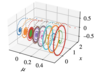 Our work on discovering nonlinear dynamical systems using a Runge–Kutta-inspired dictionary-based sparse regression approach has been published in the proceedings of the Royal Society A: Mathematical, physical and engineering science. This work demonstrated that blending numerical integration schemes with sparse regression enhances the performance, particularly for noisy and sparse data.With this first MaRDI Workshop on Scientific Computing, we want to bring together researchers from the Scientific Computing community and related disciplines who are interested in the FAIRness of their research data. Apart from presentations on the current MaRDI projects and selected keynote talks, birds-of-a-feather sessions will leave room for discussions and hands-on tutorials.
 We congratulate our multiple co-author Jack Dongarra to receiving the ACM A. M. Turing Award 2021! His contributions to software libraries, such as LINPACK, BLAS, LAPACK, ScaLAPACK, PLASMA, MAGMA, and SLATE, have a daily impact on computational experiments carried out in the group, and the concepts he co-developed have inspired several of our own contributions to the field. (Image credits: © University of Tennessee, Knoxville)
 This workshop aims to provide a coherent set of lectures that will adequately clarify the mathematical aspects of the (optimal) control of dynamical systems, with special emphasis on model reduction methods for large-scale systems and optimization. Due to the funding by the DAAD project “Accelerated solution of optimal damping problems”, a special focus lies on these specific problems.Version 2.2 of M-M.E.S.S. has been released. It is mostly a bugfix version with significantly revised documentation in places..
 here" cols="40" required >Through their activity fund, the IFAC has granted a generous support for a public Simulink model of our triple pendulum and public show events. Stay tuned for a roadmap. More details go hereVersion 2021.2.0 of pyMOR has been released. More information at pymor.org.This year's pyMOR School will be held at the WWU Münster from Monday 4th till Friday 8th of October.Version 2021.1.0 of pyMOR has been released. More information at pymor.org.
 As part of the MaRDI consortium within the NFDI, we are now filling a 5-year position as PostDoctoral Research Data Manager (m/f/d), as well as a 2-year position (initially) as Research Software Engineer (m/f/d) starting January 1, 2022.
 In the long term, contact restrictions can be lifted more quickly if younger people are immunized first. Please check out the article for more information: https://www.mpg.de/17367410/coronavirus-longterm-strategy-vaccination
 morgen - Model Order Reduction for Gas and Energy Networks - version 1.1 has been released. More information at: https://git.io/morgen
 CSC Team Leader Dr. Jens Saak has been appointed member of the editorial board of the Journal "Mathematical and Computational Applications".
 Prof. Dr. Peter Benner will join the CDS Board of Directors on August 1, 2021. He replaces Prof. Dr. Rolf Findeisen as a member of the Board of Directors.
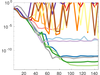 In this work C. Himpe, S. Grundel and P. Benner develop a transient gas network simulation model, test multiple adapted system-theoretic as well as data-driven model reduction algorithms, and compare model-solver-reductor ensembles.
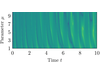 This paper by P. Benner (CSC), S. Gugercin (VT) and S. W. R. Werner (CSC) extends the framework for structure-preserving interpolation of regular subsystem transfer functions of structured bilinear control systems to the parametric system case. It got published in Automatica, a Journal of IFAC.
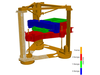 Thermal effects are the most dominant source for displacements in machine tools and thus work-piece
inaccuracies during the manufacturing process. A promising strategy to meet the ever-increasing accuracy requirements is the use of predictive models for, e.g., parameter and design optimizations or online
correction of the thermally induced error at the tool center point (TCP) in the production process. However,
these techniques require fast but precise simulations. The need for high model accuracy is in direct contrast to the desired real-time capabilities. Model order reduction (MOR) is an attractive tool to overcome
this problem. A modeling toolchain, which is tailored for the effective construction of fast and accurate
models is proposed and demonstrated, emphasizing the involved MOR step.
Thermal effects are the most dominant source for displacements in machine tools and thus work-piece
inaccuracies during the manufacturing process. A promising strategy to meet the ever-increasing accuracy requirements is the use of predictive models for, e.g., parameter and design optimizations or online
correction of the thermally induced error at the tool center point (TCP) in the production process. However,
these techniques require fast but precise simulations. The need for high model accuracy is in direct contrast to the desired real-time capabilities. Model order reduction (MOR) is an attractive tool to overcome
this problem. A modeling toolchain, which is tailored for the effective construction of fast and accurate
models is proposed and demonstrated, emphasizing the involved MOR step. Prof. Dr. Alexander Zuyev, Senior Scientist in the research group Computational Methods in Systems and Control Theory, has been elected as Corresponding Member of the "Department of Mathematics" of the National Academy of Sciences of Ukraine.
 Mechthild, the HPC system of the institute, was extended,
to fulfill the requirements of upcoming AI applications, this May. Five new
compute nodes equipped with AMD EPYC 7452 CPUs and NVidia Tesla A100 accelerators
were installed. Together with the existing GPU nodes, we now provide up to 22 accelerator devices for all kinds of applications ranging from numerical linear algebra and molecular dynamics to the
latest AI toolkits. Alongside increasing the computational power of the system, the
central storage was doubled to cope with the increased data demands.Version 2020.2.2 of pyMOR has been released. More information at pymor.org.
Mechthild, the HPC system of the institute, was extended,
to fulfill the requirements of upcoming AI applications, this May. Five new
compute nodes equipped with AMD EPYC 7452 CPUs and NVidia Tesla A100 accelerators
were installed. Together with the existing GPU nodes, we now provide up to 22 accelerator devices for all kinds of applications ranging from numerical linear algebra and molecular dynamics to the
latest AI toolkits. Alongside increasing the computational power of the system, the
central storage was doubled to cope with the increased data demands.Version 2020.2.2 of pyMOR has been released. More information at pymor.org. This paper by P. Benner (CSC), S. Gugercin (VT) and S. W. R. Werner (CSC) provides a framework for structure-preserving interpolation of regular subsystem transfer functions of structured bilinear control systems. It got published in Advances in Computational Mathematics.
 This work by Pawan Goyal (CSC) and Peter Benner (CSC) combines machine learning (dictionary-based) with a numerical integration scheme, namely a Runge-Kutta scheme to discover governing equations using
corrupted and sparsely-sampled data. The method does not require the computation of derivative information to discover governing equations. Hence, it holds a key advantage when data
are corrupted and sparsely sampled.
This work by Pawan Goyal (CSC) and Peter Benner (CSC) combines machine learning (dictionary-based) with a numerical integration scheme, namely a Runge-Kutta scheme to discover governing equations using
corrupted and sparsely-sampled data. The method does not require the computation of derivative information to discover governing equations. Hence, it holds a key advantage when data
are corrupted and sparsely sampled. This paper by Süleyman Yildiz (METU Ankara), Pawan Goyal (CSC), Peter Benner (CSC), and Bülent Karasözen (METU Ankara) discusses learning reduced models for parameterized shallow water equations using only data. The article is published in International Journal for Numerical Methods in Fluids.
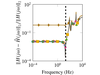 This paper by P. Benner (CSC) and S. W. R. Werner (CSC) extends the frequency- and time-limited balanced truncation methods to second-order systems and describes numerical tools for their application to large-scale sparse systems. It got published in Linear Algebra and its Applications.
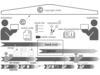 This paper by J. Fehr (Uni Stuttgart), C. Himpe (CSC), S. Rave (WWU Münster) and J. Saak (CSC) intends to be a bottom-up approach for sustainable hand-over processes in scientific software development from a developer’s perspective. It got published in the Journal of Open Research Software today.The M.E.S.S. development team releases version 2.1 of the MATLAB and OCTAVE toolbox. The new version contains further improvements to the MOR functions, as well as various minor bug fixes. Most importantly, this version provides new solvers for Lyapunov-plus-positive equations and support for the new sparss and mechss system classes in Matlab
 The BiGmax Workshop 2021 on Big-Data-Driven Materials Science will be held virtually from April 14 - 15, 2021.
The workshop is aimed at presenting results and new insights into data-driven materials science. Those can be based on approaches in statistical and machine learning, compressed sensing and other recent technologies from mathematics, computer science, statistics and information technology.
The BiGmax Workshop 2021 on Big-Data-Driven Materials Science will be held virtually from April 14 - 15, 2021.
The workshop is aimed at presenting results and new insights into data-driven materials science. Those can be based on approaches in statistical and machine learning, compressed sensing and other recent technologies from mathematics, computer science, statistics and information technology. In this manuscript, Manuela Hund, Tim Mitchell, Petar Mlinarić, and Jens Saak, propose an H2⊗L2-optimal model order reduction method for parametric linear time-invariant systems. This is the first system-theoretic parametric model order reduction method performing locally optimal approximation in an appropriate system norm, while, at the same time, allowing a broad class of parametric reduced-order models and making only mild assumptions on the full-order model. The new optimization-based algorithm moves beyond classic projection-based approaches and guarantees uniform stability of the computed reduced-order models. The preprint is available on arXiv.
 Dr. Jens Saak (CSC - DISC)and Prof. Zoran Tomljanovic (J.J. Strossmayer University of Osijek) have successfully applied for a project on accelerated solution of optimal damping problems. The DAAD supports the exchange of scientists from Magdeburg, Osijek and Zagreb in the framework of the program of project-related exchange of persons (Croatia 2021-2023) for the upcoming two years.
 CSC member Jan Heiland has obtained a positive evaluation of his Junior professorship at the OVGU. A positive evaluation spotlights the scientific and teaching activities of the last 2.5 years and is commonly acknowledged as a university lecturing qualification.
 emgr - EMpirical GRamian Framework version 5.9 for model reduction of (nonlinear) input-output systems has been released. More information at: https://gramian.de
 As of January 1, 2021 Igor Pontes Duff is appointed as team leader of SDS - Structured Dynamical Systems Group.
 As of January 1, 2021 Pawan Goyal is appointed as team leader of MLDS – Machine Learning for Dynamical Systems Group.
 Merging the forces of the Scientific Computing team and the CSC IT infrastructure team, DISC combines the knowledge about hardware and software putting the synergies to practice for the next generation HPC solutions of the CSC department.Version 2020.2.0 of pyMOR has been released. More information at pymor.org.On October 27th, the Fedora projected released the 33rd version of their Linux distribution. Beside the usual changes and updates, our FlexiBLAS library is now the default library for everything requiring the functionality of BLAS and LAPACK.
 The pyMOR Online Course 2020 (replacing the pyMOR School) will be held from Monday, September 28, till Friday, October 2, 2020.Version 2020.1.2 of pyMOR has been released. More information at pymor.org.
 GAMM Juniors' Summer School on Applied Mathematics and Mechanics (SAMM) will take place online.Version 2020.1.1 of pyMOR has been released. More information at pymor.org.
 "Honorable mention" regarding the
Householder Award 2020 has been awarded to Dr. Pawan Goyal for his PhD thesis on "System-theoretic model order reduction for bilinear and quadratic-bilinear systems".The annual CSC/DRI group retreat will be conducted virtually on BBB.emgr - EMpirical GRamian Framework version 5.8 for model reduction of (nonlinear) input-output systems has been released. More information at: https://gramian.de
"Honorable mention" regarding the
Householder Award 2020 has been awarded to Dr. Pawan Goyal for his PhD thesis on "System-theoretic model order reduction for bilinear and quadratic-bilinear systems".The annual CSC/DRI group retreat will be conducted virtually on BBB.emgr - EMpirical GRamian Framework version 5.8 for model reduction of (nonlinear) input-output systems has been released. More information at: https://gramian.de Kirandeep Kour won with 29 votes (52.7%). Jennifer Przybilla got 26 votes (47.3%). Kirandeep Kour is the external PhD representative for the period May 2020/May 2021. Jennifer Przybilla becomes the internal representative.
 Together with Dirk Wolfram (nee Siebelts, CAU Kiel), Jens Saak and Steffen W. R. Werner have been awarded best paper in the category applications of the journal at-Automatisierungstechnik in the year 2019 for their contribution "A comparison of second-order model order reduction methods for an artificial fishtail".The M.E.S.S. developers team has released version 2.0.1 of their MATLAB and OCTAVE package. The new version features minor improvements in the MOR functions, as well as some bug fixes for the DAE_1 function handles and DRE solvers.
 This workshop is the eighth in a series of workshops on matrix equations and tensor techniques. As in the previous meetings, the focus will be on the latest developments in the theory, computation and applications of linear and nonlinear matrix equations and tensor equations.
 The Scientific Computing Team of the Computational Methods in Systems and Control Theory group at the MPI in Magdeburg is holding the third workshop entitled "Power-Aware Computing - PACO2019" at the Max Planck Institute Magdeburg, Germany. The workshop aims at bringing together experts in and close to the field in a 2-day event.
 A 5 days workshop on Machine Learning in Model Reduction and Control that will be held in Shanghai, China, in October 2019. There will be 40 participants including 15 from Germany and maybe a few from other countries.
 The first ever pyMOR School will be held at the MPI Magdeburg in October 2019 from Monday 7th till Friday 11th.
 A summer school of the BiGmax Network
 4th Workshop on Model Reduction of Complex Dynamical Systems - MODRED 2019The M.E.S.S. developers team has released version 2.0 of the MATLAB and OCTAVE package. The new version features several new solvers, some usability and efficiency improvements as well as various smaller bug fixes.MORLAB - Model Order Reduction LABoratory version 5.0 for model reduction of linear systems has been released. More information at: http://www.mpi-magdeburg.mpg.de/projects/morlab
 The meeting takes place in the " Schloss Ringberg" in Tegernsee Hills
 BiGmax Workshop on BiG Data Material Science
 9th Workshop on Differential-Algebraic Equations DESCRIPTOR 2019
Paderborn (Germany) March 17 - 20, 2019
The deadline for registration is November 30, 2018.
9th Workshop on Differential-Algebraic Equations DESCRIPTOR 2019
Paderborn (Germany) March 17 - 20, 2019
The deadline for registration is November 30, 2018. emgr - EMpirical GRamian Framework version 5.7 for model reduction of (nonlinear) input-output systems has been released. More information at: https://gramian.de
 This year's SIAM Conference on Computational Science and Engineering (CSE19) is held February 25 - March 1, 2019 at the Spokane Convention Center in Spokane, Washington, USA. CSC participates with the organisation of the two minisymposia "Model Reduction and Reduced-order Modeling of Dynamical Systems" (organized by Peter Benner and Thanos Antoulas from the MPI's DRI group) and "Mathematical Methods for Control and Optimization of Large-Scale Energy Networks" (organized by Manuel Baumann and Yue Qiu). Talks are given by Manuel Baumann, Peter Benner, Igor Pontes Duff, and Steffen Werner.
 Jörg Fehr (University of Stuttgart) and Christian Himpe organize a minisymposium on "Research software and -data: How to ensure replicability, reproducibility, and reusability" at the 90th annual meeting of the international association of applied mathematics and mechanics.In this article, Davide Palitta proposes a new iterative method for solving large-scale algebraic Riccati equations. The very appealing computational features of projection methods and the convergence properties of the inexact Newton-Kleinman method are combined. Several numerical results illustrate the potential of the novel approach.
 Davide Palitta got a one-semester Postdoctoral Fellowship at the Institute for Computational and
Experimental Research in Mathematics (ICERM), Brown University, for the program "Model and dimension reduction in uncertain and dynamic systems".
https://icerm.brown.edu/programs/sp-s20/Peter Benner, Petar Mlinarić and Jens Saak participated in the kickoff meeting of the DFG project "pyMOR - Sustainable Software for Model Order Reduction" at WWU Münster.Version 0.5 of pyMOR has been released. More information at pymor.orgemgr - EMpirical GRamian Framework version 5.6 for model reduction of (nonlinear) input-output systems has been released. More information at: https://gramian.de
Davide Palitta got a one-semester Postdoctoral Fellowship at the Institute for Computational and
Experimental Research in Mathematics (ICERM), Brown University, for the program "Model and dimension reduction in uncertain and dynamic systems".
https://icerm.brown.edu/programs/sp-s20/Peter Benner, Petar Mlinarić and Jens Saak participated in the kickoff meeting of the DFG project "pyMOR - Sustainable Software for Model Order Reduction" at WWU Münster.Version 0.5 of pyMOR has been released. More information at pymor.orgemgr - EMpirical GRamian Framework version 5.6 for model reduction of (nonlinear) input-output systems has been released. More information at: https://gramian.de Peter Benner was elected to the SIAM Council. He will serve a 3-year term starting January 1, 2019. The SIAM Council formulates scientific policy of the Society, monitors technical activities, proposes new activities, and recommends action to the Board, as appropriate.
 MORLAB - Model Order Reduction LABoratory version 4.0 for model reduction of linear systems has been released. More information at: http://www.mpi-magdeburg.mpg.de/projects/morlab
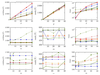 In this survey article, Peter Benner, Zvonimir Bujanović (Uni Zagreb), Patrick Kürschner and Jens Saak present a extensive comparison of low-rank solvers for large-scale algebraic Riccati equations.
 Peter Benner is visiting the Institute for Computational Engineering and Sciences (ICES) at the University of Texas in Austin as J. T. Oden Faculty Fellow from October 19 to November 2, 2018. He is hosted by the new ICES director, Prof. Karen Willcox. on October 25, he will discuss "Low-rank tensor methods for PDE-constrained optimization under uncertainty" within the ICES seminar series.
 The workshop "HPC and Data Science for Scientific Discovery", Oct. 15-19, 2018,
is part of the Long Program "Science at Extreme Scales: Where Big Data Meets Large-Scale Computing" at the Institute for Pure and Applied Mathematics (IPAM), University of California, Los Angeles (UCLA). Peter Benner presents an invited lecture "Low-rank tensor methods for simulation, optimization and uncertainty quantification of parametric PDEs", and Pawan Goyal contributes a poster.Stephan Rave (WWU Münster), Tobias Leibner (WWU Münster) and Christian Himpe developed an error-driven proper orthogonal decomposition algorithm for big data sets. The hierarchical approximate proper orthogonal decomposition (HAPOD) enables low-rank approximations on super computers with minimal communication as well as on single board computers with limited memory.
The workshop "HPC and Data Science for Scientific Discovery", Oct. 15-19, 2018,
is part of the Long Program "Science at Extreme Scales: Where Big Data Meets Large-Scale Computing" at the Institute for Pure and Applied Mathematics (IPAM), University of California, Los Angeles (UCLA). Peter Benner presents an invited lecture "Low-rank tensor methods for simulation, optimization and uncertainty quantification of parametric PDEs", and Pawan Goyal contributes a poster.Stephan Rave (WWU Münster), Tobias Leibner (WWU Münster) and Christian Himpe developed an error-driven proper orthogonal decomposition algorithm for big data sets. The hierarchical approximate proper orthogonal decomposition (HAPOD) enables low-rank approximations on super computers with minimal communication as well as on single board computers with limited memory.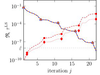 Melina Freitag (Uni Bath) and Patrick Kürschner investigate the effect of inexact linear solves in rational Krylov subspace and low-rank ADI methods for large matrix equations. Dynamic stopping criteria are developed that decrease the amount of work spent in solving the sequences of linear systems.
 The 5. EUCCO took place September 10-12, 2018, at the University of Trier. It had 106 participants. CSC contributed in the following ways: Peter Benner (program committee and talk in Special Session), Jan Heiland (organization of the Special Session "Model order reduction and low-rank approximation for nonlinear problems"), as well as Christian Himpe and Roman Weinhandl (talks in in Special Session).emgr - EMpirical GRamian Framework version 5.5 for model reduction of (nonlinear) input-output systems has been released. More information at: https://gramian.de
 The M-M.E.S.S. toolbox for Matlab is getting reinforcements. In version 1.0.0 today the C-based implementation with bindings for python and Matlab (via MEX) has been released. As of today, the C version does not support solvers for differential matrix equations, but comes with a couple of features, that are still missing in M-M.E.S.S..
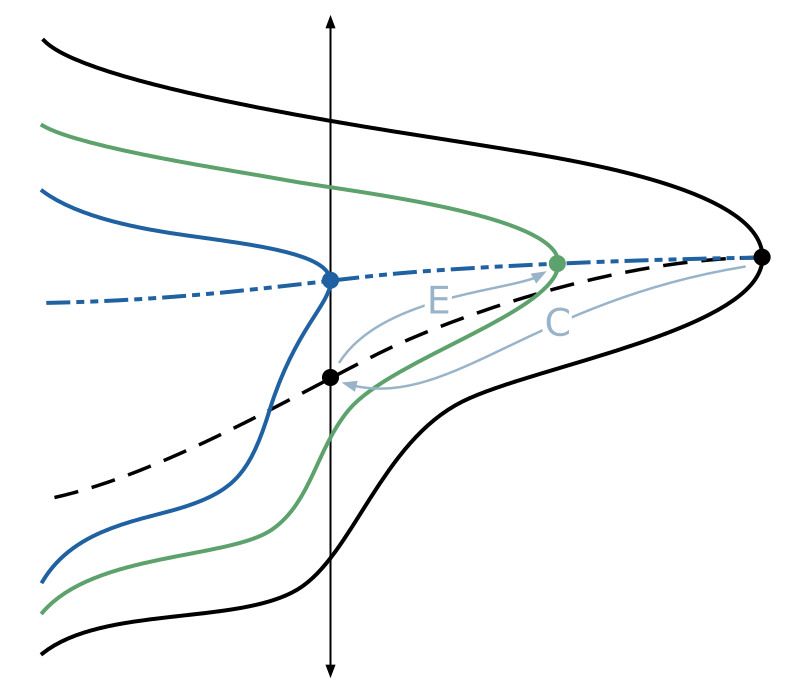 ROSTAPACK is a library implemented in MATLAB for computing or approximating robust stability measures, such as the H-infinity norm, of linear dynamical systems with input and output.emgr - EMpirical GRamian Framework version 5.4 for model reduction of input-output systems has been released. More information at: http://gramian.de
 The project, funded by the Federal Ministry of Education and Research (BMBF) in the context of the call for proposals "Mathematics for Innovations as a Contribution to the Energy transition", started in early 2018 with a term of 3 years. PI Dr. Sara Grundel and Dr. Manuel Baumann are part of the joint project. They develop, investigate and test the latest mathematical methods for the efficient and sustainable use of energy with several research institutions and partners.
Partners: TU Chemnitz, TU Ilmenau, TenneT TSO GmbH, ENSO NETZ GmbH, Venios GmbH, Energy Saxony e.V.
The project, funded by the Federal Ministry of Education and Research (BMBF) in the context of the call for proposals "Mathematics for Innovations as a Contribution to the Energy transition", started in early 2018 with a term of 3 years. PI Dr. Sara Grundel and Dr. Manuel Baumann are part of the joint project. They develop, investigate and test the latest mathematical methods for the efficient and sustainable use of energy with several research institutions and partners.
Partners: TU Chemnitz, TU Ilmenau, TenneT TSO GmbH, ENSO NETZ GmbH, Venios GmbH, Energy Saxony e.V. In April 2018, Jan Heiland, team leader within the CSC group, was appointed as assistant professor at the OVGU, Faculty of Mathematics. The W1-Junior Professorship “Numerical Methods for Descriptor Systems” will start May 1, 2018.
 Die SIAM Conference on Applied Linear Algebra (SIAM-ALA18) takes place on 4-8 May 2018 at the Hong Kong Baptist University. The CSC members Carolin Penke, Davide Palitta, and Patrick Kürschner participate with talks.
 The University of Trier is honored to be the 2018 organizer of the 5th European Conference on Computational Optimization, scheduled to take place at Trier University from September 10 to 12, 2018. Peter Benner is part of the Program Committee.
 This years CSC group workshop will take place the Burghotel Bad Belzig from June 4-6, 2018.
 A young academics workshop of the GAMM FA Numerische Analysis on theoretical and numerical aspects of DAEs. Organized by Jan Heiland and Robert Altmann.
 The BigMax Workshop 2018 on Big-Data-Driven Materials Science will be held at Kloster Irsee, Germany, April 10-13, 2018. It is aimed at presenting results and new insights on data-driven materials science. Those can be based on approaches in statistical and machine learning, compressed sensing and other recent technologies from mathematics, computer science, statistics and information technology.The 4th Conference on Model Reduction of Parametrized Systems - MoRePaS 2018 - is taking place in Nantes, France, April 10-13, 2018. Peter Benner is part of the Scientific Committee. The CSC group participates with talks given by Christian Himpe, Petar Mlinaric, Manuela Hund as well as with posters presented by Cleophas Kweyu, Yao Yue, Sara Grundel, Lihong Feng, Sridhar Chellappa, Steffen Werner, and Victor Gosea.emgr - EMpirical GRamian Framework version 5.3 for model reduction of input-output systems has been released. More information at: http://gramian.de
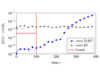 Martin Redmann (WIAS Berlin) and Patrick Kürschner propose error bounds for model reduction via time-limited balanced truncation.
 Peter Benner speaks in the Numerical Analysis and Scientific Computing Seminar of the Courant Institute at NYU on September 15 and in the Applied Mathematics and Scientific Computing Seminar at Temple University in Philadelphia on September 27. The topic of the talks is "Low-rank methods for PDE-constrained optimization under uncertainty".
 Petar Mlinaric, Ph.D. student in the CSC group and IMPRS Magdeburg, was selected as a new GAMM Junior in this year's competition. The GAMM Juniors represent the young scientists within the Gesellschaft für Angewandte Mathematik und Mechanik (GAMM). The appointment is for 3 years. Ten new GAMM Juniors are selected every year. Congatulations, Petar!This years Meeting of the GAMM activity group on applied and numerical linear algebra on September 07 and 08 in Cologne features the topic HPC. Martin Köhler and Jens Saak represented the work of the CSC group in a topical session on hybrid CPU-GPU implementations of algorithms from linear algebra.The MORLAB, Model Order Reduction Laboratory, toolbox version 3.0 has been released. More information at the project website: http://www.mpi-magdeburg.mpg.de/projects/morlab
 Patrick Kürschner is organizing a minisymposium on "Matrix equations: theory, numerics and applications" at the International Conference on Scientific Computation and Differential Equations (SciCADE) in Bath, UK. Newest group member Tony Stillfjord will also attend this minisymposium with a talk.emgr - EMpirical GRamian Framework version 5.2 for model reduction of
input-output systems has been released. More information at: http://gramian.de
Patrick Kürschner is organizing a minisymposium on "Matrix equations: theory, numerics and applications" at the International Conference on Scientific Computation and Differential Equations (SciCADE) in Bath, UK. Newest group member Tony Stillfjord will also attend this minisymposium with a talk.emgr - EMpirical GRamian Framework version 5.2 for model reduction of
input-output systems has been released. More information at: http://gramian.de Peter Benner hat als einer der Initiatoren ein neues Max Planck Research Network ins Leben gerufen. BigMax, das MaxNet on big-data-driven Materials Science, ist ein Kooperationsprojekt von 12 Max-Planck-Instituten und befasst sich mit der Analye großer Datenmengen im Bereich der Materialwissenschaften.
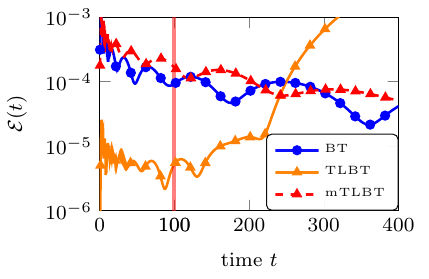 Patrick Kürschner investigates model reduction via a time-restricted balanced truncation framework. A rational Krylov subspace method is considered for dealing with the arising large scale matrix functions and equations. The numerical experiments reveal an improved accuracy in the time region of interest compared to ordinary balanced truncation.The second Workshop on PowerAware Computing is taking place at the Max Planck conference center at Ringberg castle at the Tegernsee lake. The topics have been slightly broadened as compared to the previous instance in 2015. We have found a number of well established keynote and invited speakers.emgr - EMpirical GRamian Framework version 5.1 for model reduction of
input-output systems has been released. More information at:
http://gramian.de
Patrick Kürschner investigates model reduction via a time-restricted balanced truncation framework. A rational Krylov subspace method is considered for dealing with the arising large scale matrix functions and equations. The numerical experiments reveal an improved accuracy in the time region of interest compared to ordinary balanced truncation.The second Workshop on PowerAware Computing is taking place at the Max Planck conference center at Ringberg castle at the Tegernsee lake. The topics have been slightly broadened as compared to the previous instance in 2015. We have found a number of well established keynote and invited speakers.emgr - EMpirical GRamian Framework version 5.1 for model reduction of
input-output systems has been released. More information at:
http://gramian.de The 7th workshop on "Matrix Equations and Tensor Techniques" (METT-VII) will be held in Pisa, February 13-14, 2017. The METT workshop series is organized by Peter Benner, Heike Faßbender (TU Braunschweig), Lars Grasedyck (RWTH Aachen), Daniel Kressner (EPF Lausanne) Beatrice Meini (University of Pisa,local organizer of METT-VII), and Valeria Simoncini (University of Bologna). Previous workshops were held in Leipzig (2005), Chemnitz (2007), Braunschweig (2009), Aachen (2011), Lausanne (2013), and Bologna (2015).P. Benner, H. Faßbender, M. Hinze, R. Zimmermann, T. Stykel organize the MODRED 2017, January 11-13, 2017 at the Department of Mathematics and Computer Science (IMADA), University of Southern Denmark, Odense.
 Peter Benner was re-appointed to the editorial board of the SIAM Journal on Matrix Analysis and Applications (SIMAX). He will serve his fifth term as SIMAX editor from January 1, 2017 till December 31, 2019.
 Peter Benner has been appointed to the Editorial Board of the Electronic Transactions on Numerical Analysis (ETNA) for a period of 3 years. ETNA was one of the first community-driven efforts to establish a freely accessible and purely electronic scientific journal. It was founded at Kent State University in 1993. Since then, it is supported by Kent State, and more recently, also by RICAM in Linz.In this work, Christian Kuehn and Patrick Kürschner study the numerical approximation of local fluctuations of certain classes SPDEs. Combined ERror EStimates (CERES) are developed for the four main errors: the spatial discretization error, the local linearization error, the local relaxation error to steady state, and the approximation error w.r.t. the covariance matrix computed by an iterative low-rank algorithm for Lyapunov equations.
 Peter Benner was appointed to the editorial board of the Springer journal "Advances in Computational Mathematics (ACOM)". ACOM aims to publish high quality, accessible and original articles at the forefront of applied and computational mathematics, with the clear potential for impact across the sciences. The journal places a particular emphasis on numerical methods, modeling, and simulation.The paper "Numerical solution of large-scale Lyapunov equations, Riccati equations, and linear-quadratic optimal control problems" by Peter Benner, Jing-Rebecca Li and Thilo Penzl (Numerical Linear Algebra with Applications 15(9):755-777, 2008) was named "Highly Cited Paper" by the Web of Science - it received enough citations to place it in the top 1% of the academic field of Mathematics based on a highly cited threshold for the field and publication year.emgr - EMpirical GRamian Framework for model reduction of input-output systems has been released in version 5.0. More information at: http://gramian.de.
 The Reduced Basis Summer School is an event organized by young scientists for young scientists. It aims at master students and PhD students in the field of Model Order Reduction.
 The final version of the manuscript has now been published open-access in AIMS Mathematics.
 Jens Saak and Martin Köhler will give a talk „Formeln für die Energiewende: Wie kann mit Mathematik Energie gespart werden?" within the series "Wissenschaft im Rathaus". Beginning: 7 pm. Venue: Altes Rathaus, Magdeburg.
 In September, 40 scientists mainly from China and Germany meet for a thorough discussion of 'Modelling, Model Reduction, and Optimization of Flows' in Shanghai. The workshop is organized by Shiwei Ma and Xin Du (U Shanghai) and Peter Benner and Jan Heiland and financed by the Centre for Chinese-German Cooperation CDZ.
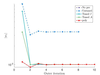 Melina Freitag, Patrick Kürschner and Jennifer Pestana present some new bounds for the convergence of
preconditioned GMRES when applied to solve the linear systems arising in
methods for large-scale, nonsymmetric eigenvalue problems.The 16th GAMM Workshop Applied and Numerical Linear Algebra took place at the Hamburg UT. Peter Benner, Jens Saak, Nicodemus Banagaaya, Patrick Kürschner and Martin Stoll from the CSC / NDS group attended. Martin Stoll, Jens Saak and Patrick Kürschner presented recent result in contributed talks.
Melina Freitag, Patrick Kürschner and Jennifer Pestana present some new bounds for the convergence of
preconditioned GMRES when applied to solve the linear systems arising in
methods for large-scale, nonsymmetric eigenvalue problems.The 16th GAMM Workshop Applied and Numerical Linear Algebra took place at the Hamburg UT. Peter Benner, Jens Saak, Nicodemus Banagaaya, Patrick Kürschner and Martin Stoll from the CSC / NDS group attended. Martin Stoll, Jens Saak and Patrick Kürschner presented recent result in contributed talks. Akwum Onwunta and Patrick Kürschner present minisymposium talks at the CMAM-7 in Jyväskylä;, Finland. Martin Stoll is coorganizing a minisymposium with Boris Khoromskij (MPI Leipzig).
 The CSC group is presenting talks by Pawan Goyal, Jan Heiland and Alexander Zuyev. Moreover, Jens Saak organizes a Minisymposium on Matrix Equations: Solvers and Applications in cooperation with Hermann Mena.
 CSC and NDS contributed several talks (Peter Benner, Jens Saak, Patrick Kürschner, Akwum Onwunta, Martin Soll, Christian Himpe, Xin Liang) to minisymposia at this year's ILAS Conference with 440 participants at KU Leuven. Furthermore, Peter Benner co-organized the invited minisymposium "Matrix Equations" jointly with Beatrice Meini (U Pisa).Reproducible and replicable numerical experiments are the basic requirement for the comparability of different methods on common benchmark examples. This article by J.Fehr, J. Heiland, Ch. Himpe and J. Saak introduces the general topic, gives guidelines for good practice in the execution of such experiments in the area of model order reduction and explains basic requirements on the underlying software for its reusability in similar use cases.
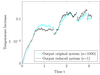 Peter Benner gives an invited lecture on
"Model Order Reduction
of Linear Stochastic Systems
Driven by Levy Noise" at the 6th Croatian Mathematical Congress in Zagreb, June 14-17, 2016. Petar Mlinaric participates with a contributed talk.
Peter Benner gives an invited lecture on
"Model Order Reduction
of Linear Stochastic Systems
Driven by Levy Noise" at the 6th Croatian Mathematical Congress in Zagreb, June 14-17, 2016. Petar Mlinaric participates with a contributed talk. Martin Köhler will present his results about an energy-efficient implementation of the Gauss-Jordan-Elimination scheme for linear systems with many right hand sides at the "Energy-Aware High Performance omputing" workshop. The workshop is part of the International Supercomputing Conference held in Frankfurt am Main from June 19th to June 23rd.
 The CSC group participates with 5 invited minisymposia and 1 contributed talks in the VII European Congress on Computational Methods in Applied Sciences and Engineering, Crete Island, June 5-10, 2016. Talks were presented by Peter Benner (2), Pawan Goyal, Martin Heß, Cleophas Kweyu, and Alexander Zuyev.The M.E.S.S. developers team has released version 1.0 of the LyaPack successor after a development time of alomst 8 years.
 The book: Index-aware Model Order Reduction Methods by Banagaaya, N., Alì, G., Schilders, W.H.A. has recently been published by Springer. Springer announces it as: "This is the first book on index-aware model order reduction methods. The splitting technique described in this book is computationally much more effective than existing methods Methods described for the
reduction of algebraic systems are new and widely applicable"
The book: Index-aware Model Order Reduction Methods by Banagaaya, N., Alì, G., Schilders, W.H.A. has recently been published by Springer. Springer announces it as: "This is the first book on index-aware model order reduction methods. The splitting technique described in this book is computationally much more effective than existing methods Methods described for the
reduction of algebraic systems are new and widely applicable" Going Open Access in scientific publishing has been discussed since the early 1990s and from the very beginnings, the Max-Planck-Society has been trying to foster and to shape this process. The arguments in favor and against Open Access are manifold and range from scientific over financial to moral aspects. Anyways, from the number of publication, a rise of Open Access publications is apparent so that Open Access is something every researcher should be aware of.
The local OA Ambassadors and the local librarian organized a well-attended, informative, and discursive workshop that featured talks by the dedicated Open Access activist Jon Tennant and Kai Geschuhn from the Max Planck Digital Library.
Going Open Access in scientific publishing has been discussed since the early 1990s and from the very beginnings, the Max-Planck-Society has been trying to foster and to shape this process. The arguments in favor and against Open Access are manifold and range from scientific over financial to moral aspects. Anyways, from the number of publication, a rise of Open Access publications is apparent so that Open Access is something every researcher should be aware of.
The local OA Ambassadors and the local librarian organized a well-attended, informative, and discursive workshop that featured talks by the dedicated Open Access activist Jon Tennant and Kai Geschuhn from the Max Planck Digital Library. A recent article in the Careers component of the Science magazine features the career of Hermann Mena.Norman Lang, Jens Saak and Tatjana Stykel present a practically realizable implementation of the balanced truncation method for linear time-varying systems in terms of a differential Lyapunov equation solver based on a symmetric indefinite factorization of the solution.Peter Benner, Zvonimir, Bujanovic, Patrick Kürschner and Jens Saak present a quadratic version of the ADI iteration for directly handling large-scale algebraic Riccati equations.
 The third workshop on Model Reduction of Parametrized Systems - MoRePaS 2015 - is taking place in Trieste, October 13-16, 2015. The workshop is co-organized by Peter Benner who is a member of the MoRePaS Executive Committee. The CSC group participates with talks given by Pawan Goyal and Alexander Zuyev as well as with posters presented by Martin Hess, Jan Heiland, Nicodemus Banagaaya, and Peter Benner.
 The fifth workshop on matrix equations and tensor techniques is held in Bologna, Italy from September 21-22, 2015. It is coorganized by the CSC group. Sergey Dolgov is a keynote speaker and Jens Saak, Heiko Weichelt, Patrick Kürschner will give contributed talks.
 The article Towards the identification of heat induction in chip removing processes via an optimal control approach has been published in Volume 9, Issue 3 of the journal Production Engineering Research and Development. It covers a numerical method based on an optimal control ansatz for the solution of inverse heat conduction problems.The CSC research group organizes the annual GAMM ANLA workshop which takes place at the Max Planck Institute Magdeburg from 9.-10. July 2015
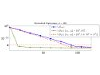 Peter Benner, Patrick Kürschner und Jens Saak present in this work computational approaches for an numerically efficient execution of frequency-limited balanced trunction for large-scale systems.Inside the project EHFARS the Scientific Computing Team is holding their initiation workshop entitled "Power-Aware Computing PACO2015" at the MPI. The workshop aims at bringing German experts in the field and our project partners from Uruguay together in a 3 day event from July 6 to 08.Peter Benner, Matthias Heinkenschloss, Jens Saak, and Heiko Weichelt combine in this preprint various methods to effciently solve large-scale algebraic Riccati equations.This conference aims at bringing together experts in the fields of numerical (linear) algebra, matrix theory, differential-algebraic equations and control theory. The conference is dedicated to Volker Mehrmann, who is a leading expert in the areas of the conference, and in a unique manner unifies expertise in the mathematical fields providing the title of this conference, on the occasion of his 60th birthday.Matthias Voigt is defending his dissertation on On Linear-Quadratic Optimal Control and Robustness of Differential-Algebraic Systemss on Monday, May 4th.
 The recently published article Riccati-based
Boundary Feedback Stabilization of Incompressible Navier-Stokes
Flows appeared in the 2nd issue of the 37th SISC volume on
pages A832-A858. The article describes efficient numerical methods
to compute a Riccati based feedback stabilization via boundary
control input for incompressible Navier-Stokes equations.
The recently published article Riccati-based
Boundary Feedback Stabilization of Incompressible Navier-Stokes
Flows appeared in the 2nd issue of the 37th SISC volume on
pages A832-A858. The article describes efficient numerical methods
to compute a Riccati based feedback stabilization via boundary
control input for incompressible Navier-Stokes equations. The article On the benefits of the LDLT factorization for large-scale differential matrix equation solvers will appear in volume 480 of the Elsevier journal Linear Algebra and its Applications. It covers efficient numerical methods for the solution of differential matrix equations.
 Prof. Harry Trentelman (University of Groningen, NL) will visit the CSC group April 15-17, 2015. He will present his work on "Model Reduction of Multi-Agent Systems Using Graph Partitions" in the Magdebug Lectures On Optimization and Control Series on April 16, 17h (Lukasklause).The article Towards the identification of heat induction in chip removing processes via an optimal control approach will appear in the journal Production Engineering Research and Development. It covers a numerical method based on an optimal control ansatz for the solution of inverse heat conduction problems.
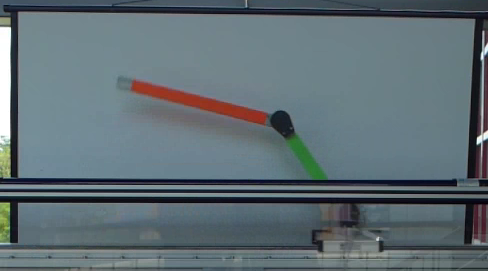 The CSC research group is looking for a student / research assistant to continue the work on the double and triple pendulum.
 The SIAM Student Chapter at TU Delft is organizing the Student Krylov Day 2015. As representatives of the SIAM Student Chapter Magdeburg, Heiko Weichelt and Patrick Kürschner will give contributed talks.The DAAD (German Academic Echange Service) project "MINLP for damping optimization" in cooperation with the J. J.
Strossmayer University in Osijek, Croatia, has been approved for the period 2015-2016. Project members are
Ninoslav Truhar,
Zoran Tomljanović,
Peter Benner,
Jonas Denißen,
Manuela Hund and
Yao Yue.
The SIAM Student Chapter at TU Delft is organizing the Student Krylov Day 2015. As representatives of the SIAM Student Chapter Magdeburg, Heiko Weichelt and Patrick Kürschner will give contributed talks.The DAAD (German Academic Echange Service) project "MINLP for damping optimization" in cooperation with the J. J.
Strossmayer University in Osijek, Croatia, has been approved for the period 2015-2016. Project members are
Ninoslav Truhar,
Zoran Tomljanović,
Peter Benner,
Jonas Denißen,
Manuela Hund and
Yao Yue. The power-aware HPC task force of the CSC group is supported by the federal ministry for science and education for a period of two years. With the help of the strategies of the German government for the internationalization of science and research we receive an amount of almost 40 000€ for travel and workshop expenses.
 The book chapter Optimal Control-Based Feedback
Stabilization of Multi-field Flow Problems appeared in the Springer book
Trends in PDE Constrained Optimization in the series
International
Series of Numerical Mathematics as volume 165 on the pages 173-188.Peter Benner, Patrick Kürschner and Jens Saak discuss a numerical algorithm for solving large-scale, nonsymmetric algebraic Ricatti equations, which combines a Newton's method with the low-rank ADI iteration for Sylvester equations.Peter Benner, Jens Saak and M. Monir Uddin combine an approach for Balanced truncation of unstable systems with the efficient treatment of Stokes-like index-2 DAE structures and the latest techniques for implementing the low-rank ADI as well as choosing appropriate ADI shifts.Martin Köhler und Jens Saak have extended the already optimized methods for the solution of matrix Lyapunov equations with (quasi) triangular coefficient matrices to support accelerator devices. Thus, they have shown the main problems of using an accelerator device in the Bartels-Stewart algorithm and presented mathematical solutions for these problems.Peter Benner, Jonas Denißen, Patrick Kürschner and Jens Saak attend the workshop within the DAAD project Optimal Damping of Vibrating Systems in Osijek (Croatia). The workshop is supported by the German Academic Exchange Service (DAAD), Zeidler-Forschungs-Stiftung and the department of mathematics, J. J. Strossmayer University of Osijek.This years second meeting of the GAMM activity group on "Dynamics and Control" will take place together with the GMA activity groups 1.30 and 1.40 as usual on a bi-anual basis. The meeting is scheduled September 22 to 26 at the Momentum hotel Anif near Salzburg. The talks of the GAMM activity group will take place on Wednesday 24th and contain contributions by Peter Benner and Norman Lang. Also Jens Saak gives a talk in the GMA activity group 1.30 on Friday September 26.Martin Köhler und Jens Saak have extended existing methods for the solution of matrix Lyapunov equations with (quasi) triangular coefficient matrices from Blas level-2 to level-3. Thus, they have optimized the exploitation of modern computer architectures and achieved acceleration of the execution by notable factors.
The book chapter Optimal Control-Based Feedback
Stabilization of Multi-field Flow Problems appeared in the Springer book
Trends in PDE Constrained Optimization in the series
International
Series of Numerical Mathematics as volume 165 on the pages 173-188.Peter Benner, Patrick Kürschner and Jens Saak discuss a numerical algorithm for solving large-scale, nonsymmetric algebraic Ricatti equations, which combines a Newton's method with the low-rank ADI iteration for Sylvester equations.Peter Benner, Jens Saak and M. Monir Uddin combine an approach for Balanced truncation of unstable systems with the efficient treatment of Stokes-like index-2 DAE structures and the latest techniques for implementing the low-rank ADI as well as choosing appropriate ADI shifts.Martin Köhler und Jens Saak have extended the already optimized methods for the solution of matrix Lyapunov equations with (quasi) triangular coefficient matrices to support accelerator devices. Thus, they have shown the main problems of using an accelerator device in the Bartels-Stewart algorithm and presented mathematical solutions for these problems.Peter Benner, Jonas Denißen, Patrick Kürschner and Jens Saak attend the workshop within the DAAD project Optimal Damping of Vibrating Systems in Osijek (Croatia). The workshop is supported by the German Academic Exchange Service (DAAD), Zeidler-Forschungs-Stiftung and the department of mathematics, J. J. Strossmayer University of Osijek.This years second meeting of the GAMM activity group on "Dynamics and Control" will take place together with the GMA activity groups 1.30 and 1.40 as usual on a bi-anual basis. The meeting is scheduled September 22 to 26 at the Momentum hotel Anif near Salzburg. The talks of the GAMM activity group will take place on Wednesday 24th and contain contributions by Peter Benner and Norman Lang. Also Jens Saak gives a talk in the GMA activity group 1.30 on Friday September 26.Martin Köhler und Jens Saak have extended existing methods for the solution of matrix Lyapunov equations with (quasi) triangular coefficient matrices from Blas level-2 to level-3. Thus, they have optimized the exploitation of modern computer architectures and achieved acceleration of the execution by notable factors. Within the Hot Topic session on Mathematics in developing countries at the Heidelberg Laureate forum, Peter Benner and Hermann Mena (University of Innsbruck) will jointly speak about their former German-Ecuadorian cooperation on simulating the spray-drift at the Ecuador-Colombian border caused by spraying herbicides to destroy coca plants. See Max Planck Research 1/2014 for details of the project.The 3rd Symposium of the German SIAM Student Chapters
toke place in Magdeburg on 28.-29. of August 2014. We welcomed
guest from the other German SIAM Chapters in Heidelberg
and Trier. For the first time, members of the SIAM
Chapter in Prag participated to extend the international connections.The article "Model Order Reduction for Systems with Moving Loads" by Peter Benner, Norman Lang and Jens Saak has been published at June 28 2014, in De Gruyter Oldenbourg: at-Automatisierungstechnik: volume 62 (7).
Within the Hot Topic session on Mathematics in developing countries at the Heidelberg Laureate forum, Peter Benner and Hermann Mena (University of Innsbruck) will jointly speak about their former German-Ecuadorian cooperation on simulating the spray-drift at the Ecuador-Colombian border caused by spraying herbicides to destroy coca plants. See Max Planck Research 1/2014 for details of the project.The 3rd Symposium of the German SIAM Student Chapters
toke place in Magdeburg on 28.-29. of August 2014. We welcomed
guest from the other German SIAM Chapters in Heidelberg
and Trier. For the first time, members of the SIAM
Chapter in Prag participated to extend the international connections.The article "Model Order Reduction for Systems with Moving Loads" by Peter Benner, Norman Lang and Jens Saak has been published at June 28 2014, in De Gruyter Oldenbourg: at-Automatisierungstechnik: volume 62 (7). Norman Lang, Hermann Mena, and Jens Saak present an LDLT based version of the standard low-rank Lyapunov solvers based on ADI or Krylov subspace methods. The method allows us to avoid complex arithmetic for the solution of matrix differential equations via higher order time integration methods, as well as the a priori reduction of the number of columns in the right hand side of the arising algebraic Lyapunov equations inside of the time integration loop.Peter Benner, Ernesto Dufrechou, Pablo Ezzatti, Enrique S. Quintana-Orti and Alfredo Remon present an extension of the Lyapack library to solve band Lyapunov equations in CPU-GPU platforms. The approach exploits the modular structure in Lyapack, to incorporate a set of tuned routines that exploit the features of the problem and leverage the parallelism of current CPU-GPU platforms.Peter Benner, Patrick Kürschner, Zoran Tomljanović, and Ninoslav Truhar present an approach to compute the optimal gain which minimizes the impulse response energy of a vibrational system. The used method employs the parametric dominant pole algorithm to produce reduced order models in order to decrease the computational cost of the optimization procedure.Patrick Kürschner and Jens Saak presented their
respective latest results on the efficient computation of frequency
limited Gramain matrices and inexact Newton based solution of the
LQR problem for linearized flow problems at the joint meeting of the
GAMM ANLA and its spanish counterpart ALAMA that took place in Barcelona July 14-16. Peter Benner acted as part of the organizing commitee.Martin Köhler and Jens Saak participate at the 8th International Workshop on Parallel Matrix Algorithms and Applications (PMAA14) from 2nd to 4th July 2014 in Lugano. Martin Köhler presented a new efficient implementation of the Bartels-Stewart Algorithm for the solution of dense generalized Lyapunov equations. Our software library FlexiBLAS was presented by Jens Saak.
Norman Lang, Hermann Mena, and Jens Saak present an LDLT based version of the standard low-rank Lyapunov solvers based on ADI or Krylov subspace methods. The method allows us to avoid complex arithmetic for the solution of matrix differential equations via higher order time integration methods, as well as the a priori reduction of the number of columns in the right hand side of the arising algebraic Lyapunov equations inside of the time integration loop.Peter Benner, Ernesto Dufrechou, Pablo Ezzatti, Enrique S. Quintana-Orti and Alfredo Remon present an extension of the Lyapack library to solve band Lyapunov equations in CPU-GPU platforms. The approach exploits the modular structure in Lyapack, to incorporate a set of tuned routines that exploit the features of the problem and leverage the parallelism of current CPU-GPU platforms.Peter Benner, Patrick Kürschner, Zoran Tomljanović, and Ninoslav Truhar present an approach to compute the optimal gain which minimizes the impulse response energy of a vibrational system. The used method employs the parametric dominant pole algorithm to produce reduced order models in order to decrease the computational cost of the optimization procedure.Patrick Kürschner and Jens Saak presented their
respective latest results on the efficient computation of frequency
limited Gramain matrices and inexact Newton based solution of the
LQR problem for linearized flow problems at the joint meeting of the
GAMM ANLA and its spanish counterpart ALAMA that took place in Barcelona July 14-16. Peter Benner acted as part of the organizing commitee.Martin Köhler and Jens Saak participate at the 8th International Workshop on Parallel Matrix Algorithms and Applications (PMAA14) from 2nd to 4th July 2014 in Lugano. Martin Köhler presented a new efficient implementation of the Bartels-Stewart Algorithm for the solution of dense generalized Lyapunov equations. Our software library FlexiBLAS was presented by Jens Saak. The Householder Symposium XIX on numerical linear
algebra took place in Spa (Belgium) from 06/08 - 06/13. The CSC
group was represented by talks of Peter Benner, Martin Stoll and
Patrick Kürschner as well as by a poster of Matthias Voigt.The GAMM ANLA / MSIP workshop was coorganized by Peter Benner and brought together people from the communities of sparse recovery and matrix computations. The CSC group was represented by Ulrike Baur, Jonas Denissen, and Jan Heiland.The 85th Annual Meeting of the International
Association of Applied Mathematics and Mechanics is taking place in
Erlangen, Germany. Patrick Kürschner, Jens Saak, Jonas
Denißen, Norman Lang, Akwum Onwunta, Björn Baran, Ulrike Baur,
Zvonimir Bujanovic, Jan Heiland, Martin Köhler, Matthias Voigt, and Sara Grundel will give talks in the contributed sections.
The Householder Symposium XIX on numerical linear
algebra took place in Spa (Belgium) from 06/08 - 06/13. The CSC
group was represented by talks of Peter Benner, Martin Stoll and
Patrick Kürschner as well as by a poster of Matthias Voigt.The GAMM ANLA / MSIP workshop was coorganized by Peter Benner and brought together people from the communities of sparse recovery and matrix computations. The CSC group was represented by Ulrike Baur, Jonas Denissen, and Jan Heiland.The 85th Annual Meeting of the International
Association of Applied Mathematics and Mechanics is taking place in
Erlangen, Germany. Patrick Kürschner, Jens Saak, Jonas
Denißen, Norman Lang, Akwum Onwunta, Björn Baran, Ulrike Baur,
Zvonimir Bujanovic, Jan Heiland, Martin Köhler, Matthias Voigt, and Sara Grundel will give talks in the contributed sections. At the 9. Elgersburg Workshop M. Voigt and P. Kürschner represent the Computational Methods in Systems and Control Theory
group by two talks.The recent issue of SIAM News (Januar 2014) reports
about the opening workshop of the SIAM Student Chapter Magdeburg. The
workshop took place at the MPI Magdeburg on June 19th 2013. Edda Klipp from the Humboldt University Berlin was invited as the main speaker.
At the 9. Elgersburg Workshop M. Voigt and P. Kürschner represent the Computational Methods in Systems and Control Theory
group by two talks.The recent issue of SIAM News (Januar 2014) reports
about the opening workshop of the SIAM Student Chapter Magdeburg. The
workshop took place at the MPI Magdeburg on June 19th 2013. Edda Klipp from the Humboldt University Berlin was invited as the main speaker. The Zeidler-Forschungs-Stiftung supports the project "Optimal damping of vibrating systems" by a 50.000 Euro grant. Project partner of the Max Planck Institute is the J. J. Strossmayer University in Osijek (Croatia).
 Martin Köhler and Jens Saak publish LAPACK Working Note #284 on a plugin based BLAS implementation that allows to switch the BLAS library used by a program at runtime without the need for recompilation or the requirement for any super user privileges.
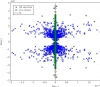 Numerical methods for eigenvalue problems associated to alternating matrix pencils and polynomials are discussed. These problems arise in a large number of control applications for differential-algebraic equations ranging from regular and singular linear-quadratic optimal and robust control to dissipativity checking. We present a survey of several of these applications and give a systematic overview over the theory and the numerical solution methods. Our solution concept is based throughout on the computation of eigenvalues and de flating subspaces of even matrix pencils. The unified approach allows to generalize and improve several techniques that are currently in use in systems and control.
 Peter Benner, Martin Hess, and Judith Schneider organize the ModRed 2013 as dissemination workshop of the BMBF research network MoreSim4Nano, December 11-13, 2013, MPI Magdeburg (Germany).
 On December 10-th 2013 Björn Baran will defend his Bachelor thesis by the topic "Numerisches Lösen großer dünnbesetzter Matrixgleichungen in Python". The colloquium will be held in English language. It starts 13:30 in the Seminar room Prigogine at the MPI.The Computational Methods in Systems and Control Theory group is proud to welcome a number of new group members. Jan Heiland and Xin Du are starting as new Post Docs, Christian Miller switches status to a research assistant and Carolin Penke and Steffen Hermann take up their work as student assistants of the group.
 The M.E.S.S. software suite is the successor of the obsolete LyaPack MATLAB® toolbox for solving large scale matrix equations and related problems. The software suite consists of a new MATLAB toolbox and a separate C library C-M.E.S.S. which works independent from MATLAB. Due to the fact that many scientists use Python with NumPy and SciPy for their everyday work we want to provide the key algorithm of M.E.S.S. for them, too. In this report Björn Baran, Martin Köhler, Nitin Prasad and Jens Saak describe how to build an interface between Python and C-M.E.S.S. on top of the NumPy/SciPy-Python libraries.
 Peter Benner, Patrick Kürschner, and Matthias Voigt participate as invited guests in the Oberwolfach Workshop: Numerical Solution of PDE Eigenvalue Problems (11/17 - 11/23/13). Patrick Kürschner and Matthias Voigt are supported as Oberwolfach Leibniz Graduate Students (OWLG).
 The third colloquium of the SFB/TR-96 takes place in Aachen from 29th to 30th of october. For further informations have a look at the official webpage of the SFB/TR-96
 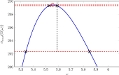 In this report, we implement a method for computing L∞-norms for descriptor systems using structured iterative eigensolvers. In particular, the algorithm computes some desired imaginary eigenvalues of an even matrix pencil and uses them to determine an upper and lower bound to the L∞-norm. We finally compare our method to a previously developed algorithm using structured pseudospectra. Numerical examples demonstrate the reliability and accuracy of the new method along with a significant drop in the runtime.Structure-Preserving Balancing of Matrix Pencils Arising in Linear-Quadratic
Optimal Control
In this report, we implement a method for computing L∞-norms for descriptor systems using structured iterative eigensolvers. In particular, the algorithm computes some desired imaginary eigenvalues of an even matrix pencil and uses them to determine an upper and lower bound to the L∞-norm. We finally compare our method to a previously developed algorithm using structured pseudospectra. Numerical examples demonstrate the reliability and accuracy of the new method along with a significant drop in the runtime.Structure-Preserving Balancing of Matrix Pencils Arising in Linear-Quadratic
Optimal Control Fast Numerical Computation of Structured Real Stability Radii for Large-Scale
Matrices and Pencils
Fast Numerical Computation of Structured Real Stability Radii for Large-Scale
Matrices and Pencils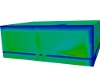 The authors combine stochastic collocation methods and Monte Carlo simulation with proper orthogonal decomposition
and apply it to a coplanar waveguide with uncertain material parameters.The authors present novel shift strategies for low-rank
ADI methods for the numerical solution of large-scale Lyapunov and Sylvester
equations. In the proposed approaches shift parameters are computed
automatically during the ADI iteration. Numerical test show that these new
shifts outperform existing strategies in several cases, especially for problems
with complex spectra.
The authors combine stochastic collocation methods and Monte Carlo simulation with proper orthogonal decomposition
and apply it to a coplanar waveguide with uncertain material parameters.The authors present novel shift strategies for low-rank
ADI methods for the numerical solution of large-scale Lyapunov and Sylvester
equations. In the proposed approaches shift parameters are computed
automatically during the ADI iteration. Numerical test show that these new
shifts outperform existing strategies in several cases, especially for problems
with complex spectra.
The model reduction method introduced in [Benner, P. and Schneider, A.; Balanced Truncation Model Order Reduction for LTI Systems with many Inputs or Outputs, in A. Edelmayer: Proceedings of the 19th International Symposium on Mathematical Theory of Networks and Systems, 2010, ISBN/ISSN: 978-963-311-370-7] shows how to reduce linear time-invariant (LTI) continuous-time state space systems with either many inputs or many outputs using the well-known balanced truncation approach. We call this method balanced truncation for many terminals (BTMT). In this work we generalize BTMT to descriptor systems of the form
Eẋ(t) = Ax(t) + Bu(t), A, E ∈ ℝn×n,B ∈ ℝn×m
y(t) = Cx(t) + Du(t), C ∈ ℝp×n, D∈ ℝp×m,
where m ∈ 𝒪(n) and p ≪ n, or vice versa. We show how to obtain a reduced order model by solving one Lyapunov equation and using the Gauss-Kronrod quadrature to compute the needed projection matrices. In particular, we discuss the case when E is singular and show numerical results.
This paper presents the results obtained within the SPP1253 project: Optimal Control-Based Feedback Stabilization in Multi-Field Flow Problems .Norman Lang, Jens Saak und Matthias Voigt present parts of their research results at the GMA activity group 1.30 from September 18 to September 20 at the Momentum hotel in Anif (Salzburg). Peter Benner is co-organizer (with Heike Faßbender, Lars Grasedyck, Daniel Kressner) of the 5th Workshop on Matrix Equations and Tensor Techniques, October 10-11, 2013, EPF Lausanne (Switzerland).The GAMM Workshop Applied and Numerical Linear Algebra will take place at the Bergische Universität Wuppertal from 09/09 - 09/10/2013. Peter Benner, Matthias Voigt, Jens Saak, Jessica Bosch und Patrick Kürschner are participants and in part give contributed talks.The next workshop of the GAMM activity group ”Dynamics and Control Theory“ will take place at the MPI Magdeburg from 09/26 - 09/27/2013. The local organizer and contact is Matthias Voigt.Skew-Hamiltonian/Hamiltonian matrix pencils λS - H appear in many applications, including linear quadratic optimal control problems, H∞-optimization, certain multi-body systems and many other areas in applied mathematics, physics, and chemistry. In these applications it is necessary to compute certain eigenvalues and/or corresponding deflating subspaces of these matrix pencils. Recently developed methods exploit and preserve the skew-Hamiltonian/Hamiltonian structure and hence increase reliability, accuracy and performance of the computations. In this paper we describe the corresponding algorithms which have been implemented in the style of subroutines of the Subroutine Library in Control Theory (SLICOT). Furthermore, we address some of their applications. We describe variants for real and complex problems with versions for factored and unfactored matrices S.In this paper we describe the implementation of the algorithms in the style of subroutine included in the Subroutine Library in Control Theory (SLICOT) described in Part I of this work and address various details. Furthermore, we perform numerical tests using real-world examples to demonstrate the superiority of the new algorithms compared to standard methods.
  Peter Benner is member of the scientific committee of the ENUMATH 2013, August 26-30 2013, EPFL Lausanne (Switzerland). Martin Stoll, Peter Benner will give minisymposia, and H. Yücel, Y. Zhang and Martin Heß contributed talks.
 Heiko Weichelt will present his latest results about Preconditioning of Large-Scale Saddle Point Systems Arising in Riccati Feedback Stabilization of Coupled Flow Problems at
the PIM2013 in Prague (Czech Republic).
Heiko Weichelt will present his latest results about Preconditioning of Large-Scale Saddle Point Systems Arising in Riccati Feedback Stabilization of Coupled Flow Problems at
the PIM2013 in Prague (Czech Republic).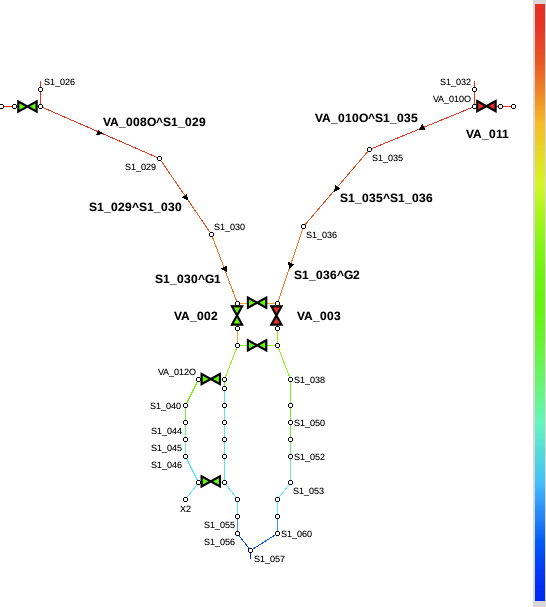 We explore the Tractability Index of Differential Algebraic Equations (DAEs) that emerge in the simulation of gas transport networks. Depending on the complexity of the network, systems of index~1 or index~2 can arise. We then apply Model Order Reduction (MOR) techniques such as Proper Orthogonal Decomposition (POD) to a network of moderate size and complexity and show that one can reduce the system size significantly. This can be either achieved by directly reducing the original DAE~formulation or by applying MOR to an index-reduced system. First numerical results are reported on.
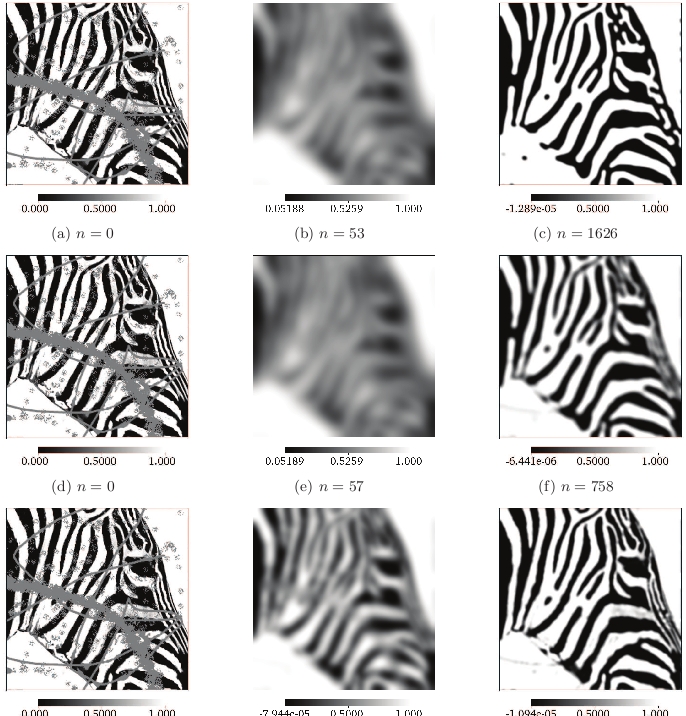 We consider the efficient solution of the modified Cahn-Hilliard equation for binary image inpainting using convexity splitting, which allows an unconditionally gradient stable time-discretization scheme. We look at a double-well as well as a double obstacle potential. For the latter we get a nonlinear system for which we apply a semi-smooth Newton method combined with a Moreau-Yosida regularization technique. At the heart of both methods lies the solution of large and sparse linear systems. We introduce and study block-triangular preconditioners using an efficient and easy to apply Schur complement approximation. Numerical results indicate that our preconditioners work very well for both problems and show that qualitatively better results can be obtained using the double obstacle potential.
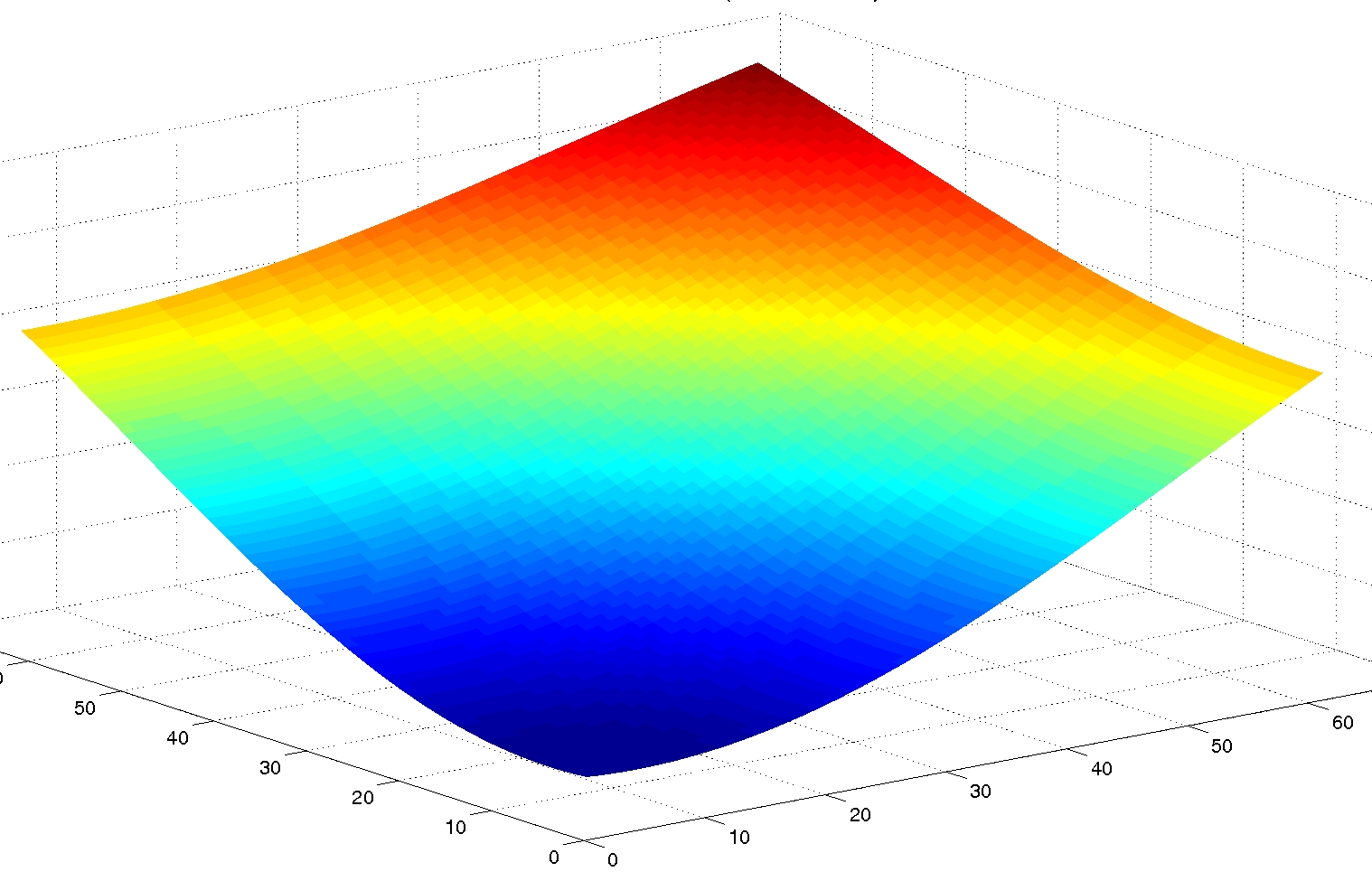 The solution of time-dependent PDE-constrained optimization problems is a challenging task in numerical analysis and applied mathematics. All-at-once discretizations and corresponding solvers provide efficient methods to robustly solve the arising discretized equations. One of the drawbacks of this approach is the high storage demand for the vectors representing the discrete space-time cylinder. We here introduce a low-rank in time technique that exploits the low-rank nature of the solution. The theoretical foundations for this approach originate in the numerical treatment of matrix equations and can be carried over to PDE-constrained optimization. We illustrate how three different problems can be rewritten and used within a low-rank Krylov subspace solver with appropriate preconditioning.Efficient numerical algorithms for the solution of large and sparse matrix Riccati and Lyapunov equations based on the low rank alternating directions implicit (ADI) iteration have become available around the year 2000. Over the decade that passed since then, additional methods based on extended and rational Krylov subspace projection have entered the field and proved to be competitive alternatives. In this survey we sketch both types of methods and discuss their advantages and drawbacks. We focus on the continuous time case here, but corresponding results for discrete time problems can for most results be found in the available literature and will be referred to throughout the paper.
  The Numerical Analysis and Scientific Computation with Applications (NASCA13) conference will take place in Calais, France from 06/24 - 06/26/2013. Peter Benner gives an invited and Patrick Kürschner a contributed presentation.The CSC group is participating at this years Preconditioning meeting in Oxford, UK. Jessica Bosch and Andrew Barker are giving contributed talks and Martin Stoll is giving a plenary lecture. Additionally.
Andrew will spend the week prior to the meeting at OCCAM collaborating with John Pearson (Oxford) and Tyron Rees (RAL).
The Numerical Analysis and Scientific Computation with Applications (NASCA13) conference will take place in Calais, France from 06/24 - 06/26/2013. Peter Benner gives an invited and Patrick Kürschner a contributed presentation.The CSC group is participating at this years Preconditioning meeting in Oxford, UK. Jessica Bosch and Andrew Barker are giving contributed talks and Martin Stoll is giving a plenary lecture. Additionally.
Andrew will spend the week prior to the meeting at OCCAM collaborating with John Pearson (Oxford) and Tyron Rees (RAL). Peter Benner is member of the organizing committee of the European Conference on Computational Optimization (EUCCO), July 17-19, 2013, Chemnitz, Germany.
 Ryan Lowe from Queen's University in Kingston starts as an intern and will investigate a new approach for the computation of the L∞-norm for descriptor systems of high dimension. The internship is funded by a grant from the DAAD RISE program.Thomas Hughes from the Queen's University at Kingston starts as intern and will investigate efficient techniques for ℋ2 model reduction of bilinear systems.
 Peter Benner will co-organize (with Albert Cohen, Mario Ohlberger, Karen Willcox) the CIRM workshop Model Reduction and Approximation for Complex Systems, June 10-14, 2013, CIRM Luminy, France. Ulrike Baur, Patrick Kürschner, Tobias Breiten, Lihong Feng and Sara Grundel from the CSC group will also participate.
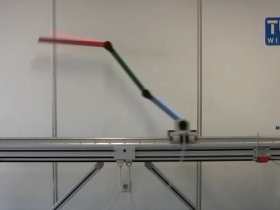 Deepak Matcha Venkat from IIT Bombay starts as anintern and will investigate the two-degree of freedom control of the double and triple pendulum.Peter Benner and Patrick Kürschner present new results and numerical
enhancements for the low-rank ADI iteration for large-scale Sylvester matrix equations.
Deepak Matcha Venkat from IIT Bombay starts as anintern and will investigate the two-degree of freedom control of the double and triple pendulum.Peter Benner and Patrick Kürschner present new results and numerical
enhancements for the low-rank ADI iteration for large-scale Sylvester matrix equations. The Computational Methods in Systems and Control Theory group is proud to welcome Dr. Alfredo Remón as a new group member. Dr. Remón has been a long term cooperation partner of the group in the field of Multicore and GPU Computing. He received his PhD in the group of Prof. E. Quintana-Ortí at UJI Castellon (Spain)
  Melina Freitag (University of Bath) and Patrick Kürschner present new results regarding
convergence and preconditioning of inexact two-sided eigenvalue iterations.
A novel equivalence results between those methods and a simplified two-sided Jacobi-Davidson is also established.Christian Miller from the FH Kempten starts as student research assistant and diploma candidate. He will investigate the swing-up of the double and triple pendulum via feedforward control. The obtained results will be validated on a real pendulum experiment.On April 1st Björn Baran started as a new student research assistant in the M.E.S.S. project. His main duties will be the implementation of recent algorithmic advances in the Matlab version. In his Bachelor thesis he will then port these new codes to Python and compare this implementation with simple python interface functions to the C version of M.E.S.S.The 84th Annual Meeting of the International Association of Applied Mathematics and Mechanics is taking place in Novi Sad, Serbia. Peter Benner, Tobias Breiten, Patrick Kürschner, Jessica Bosch, Jens Saak, Martin Redmann, Jonas Denißen and Norman Lang will give talks in the contributed sections.
Melina Freitag (University of Bath) and Patrick Kürschner present new results regarding
convergence and preconditioning of inexact two-sided eigenvalue iterations.
A novel equivalence results between those methods and a simplified two-sided Jacobi-Davidson is also established.Christian Miller from the FH Kempten starts as student research assistant and diploma candidate. He will investigate the swing-up of the double and triple pendulum via feedforward control. The obtained results will be validated on a real pendulum experiment.On April 1st Björn Baran started as a new student research assistant in the M.E.S.S. project. His main duties will be the implementation of recent algorithmic advances in the Matlab version. In his Bachelor thesis he will then port these new codes to Python and compare this implementation with simple python interface functions to the C version of M.E.S.S.The 84th Annual Meeting of the International Association of Applied Mathematics and Mechanics is taking place in Novi Sad, Serbia. Peter Benner, Tobias Breiten, Patrick Kürschner, Jessica Bosch, Jens Saak, Martin Redmann, Jonas Denißen and Norman Lang will give talks in the contributed sections. Heiko Weichelt presented his latest results about Riccati-Based Boundary Feedback Stabilization of Multi-Field Flow Problems at the OCIP2013 in Garching by Munich (Germany).Jonas Denißen visits the J. J. Strossmayer University of Osijek, Department of Mathematics, Osijek, Croatia in the period March 10 - 17, 2013. The purpose of his stay is to work with Zoran Tomljanović on the DAAD project "Optimal damping of vibrating systems".The final meeting of the DFG SPP1253 Optimization with Partial Differential Equations was held at Banz monastery. Peter Benner, Heiko Weichelt and Jens Saak participated and presented the latest results of the local project Optimal Control-Based Feedback Stabilization of Multi-Field Flow Problems there. (Talk ca. 16MB as PDF)
 The Computational Methods in Systems and Control Theory group is proud to welcome Dr. Zvonimir Bujanovic as a new group member. Dr. Bujanovic revieved his PhD degree from University of Zagreb under the supervision of Prof. Zlatko Drmac.
 A book: System-level Modeling of MEMS edited by Tamara Bechtold, Gabriele Schrag and Lihong Feng is published in January, 2013 by WILEY-VCH. This book is a volume of the series: Advanced Micro & Nanosystems edited by Brand, Fedder, Hierold, Korvink and Tabata.On this years Elgersburg Workshop the Computational Methods in Systems and Control Theory is presenting three talks by P. Benner, M. Redmann and M.Voigt. Additionally, U. Baur, T. Breiten, J. Denißen and J. Saak are participating.
 Zoran Tomljanović from the J. J. Strossmayer University of Osijek, Department of Mathematics, Osijek, Croatia visits CSC in the period February 5 - 20, 2013. The purpose of his stay is to work with Peter Benner, Jonas Denißen, Patrick Kürschner and Matthias Voigt on the newly approved DAAD project "Optimal damping of vibrating systems".Sandra Kutz (student of applied mathematics at OvGU) is investigating the capabilities and limitations of Matlabs GPU computing toolbox in the context of solvers for large and sparse matrix equations during a 5 week internship.A meeting of the working group parameterization and simulation of the SFB/TR-96 takes place in Dresden from 31st of January to 1st of February. For further informations have a look at the official webpage of the SFB/TR-96
  Peter Benner and Wolfgang Hackbusch (MPI Leipzig) are (co-)organizing the GAMM Seminar Numerical Methods for Uncertainty Quantification at the MPI for Mathematics in the Sciences Leipzig, Germany. Martin Heß, Ulrike Baur, Akwun Onwunta, Kapil Ahuja and Martin Redmann from the CSC group will also participate.The CSC group is proud to welcome Mian Ilyas Ahmad (Nust, Pakistan), Andrew Barker (LSU, USA), Yao Yue (Leuven, Belgium) as postdocs and Jessica Bosch (Oxford, UK) as a PhD student.
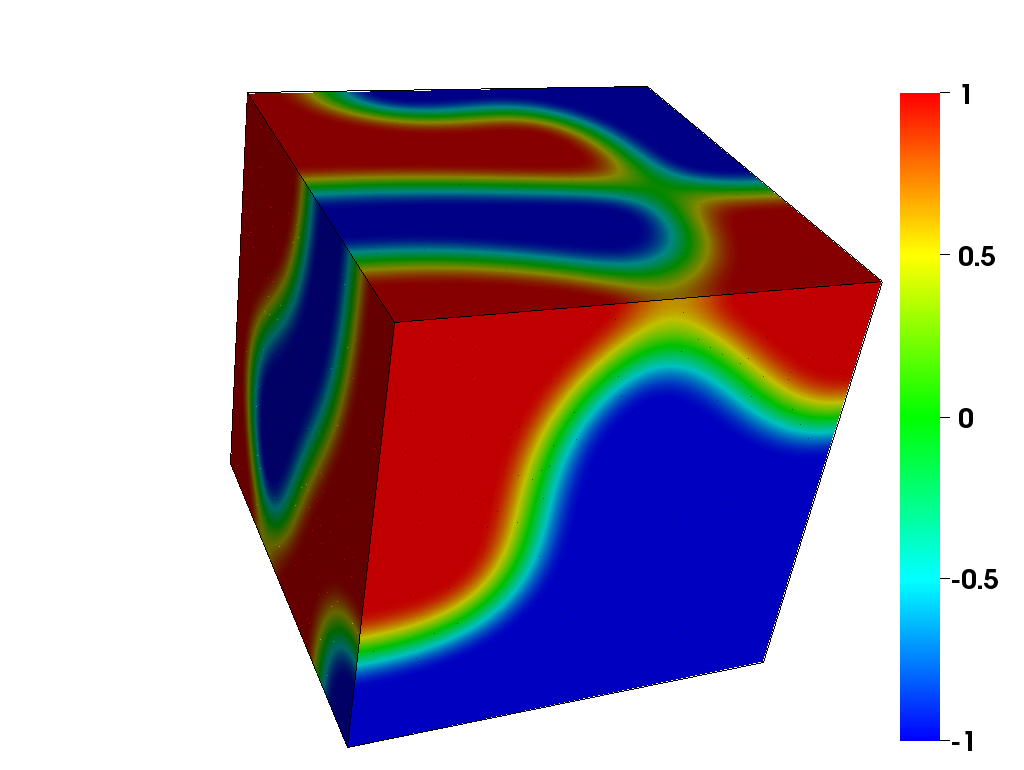 We consider the effcient solution of the Cahn-Hilliard variational inequality using an implicit time discretization, which is formulated as an optimal control problem with pointwise constraints on the control. By applying a semi-smooth Newton method combined with a Moreau-Yosida regularization technique for handling the control constraints we show superlinear convergence in function space. At the heart of this method lies the solution of large and sparse linear systems for which we propose the use of preconditioned Krylov subspace solvers using an effective Schur complement approximation. Numerical results illustrate the competitiveness of this approach.The DAAD (German Academic Echange Service) exchange project project "Optimal damping of vibrating systems" with Croatia for 2013-2014 has been approved. Projectmembers are Ninoslav Truhar, Zoran Tomljanović, Peter Benner, Jonas Denißen, Patrick Kürschner and Matthias Voigt.Model order recuction using balanced truncation for differential algebraic second order systems in M.E.S.S.Numerical Solution of large and sparse matrix equations on distributed memory parallel machinesApproximate solution of the Linear systems of equations in the ADI Method for large and sparse matrix equationsA CG-Method with ADI preconditioning for the solution of large sparse Lyapunov equations with symmetric coefficient matricesStep size control for the numerical solution of large and sparse matrix differential Riccati equations
 Judith and André Schneider will participate in the Kickoff Meeting of the Scientific Network at TU Darmstadt.The article Computation of a Compact State Space Model for an Adaptive Spindle Head Configuration with Piezo Actuators using Balanced Truncation will appear in volume 6 issue 6 of the Springer journal Production Engineering Research and Development. It covers efficient numerical methods for the model order reduction of the resulting index 1 differential algebraic systems via balanced truncation.We consider balanced truncation model order reduction for symmetric second order systems. The occurring large-scale generalized and structured Lyapunov equations are solved with a specially adapted low-rank ADI type method. Stopping criteria for this iteration are investigated and a new result concerning the Lyapunov residual within the low-rank ADI method is established. We also propose a goal oriented stopping criterion which tries to incorporate the balanced truncation approach already during the ADI iteration. The model reduction approach using the ADI method with different stopping criteria is evaluated on several test systems.
 On Thursday November 08 and Friady November 09 Heiko Panzer and Thomas Wolf from "Lehrstuhl für Regelungstechnik" (Prof. B. Lohmann) at TU Munich will be visiting CSC. In a seminar double feature on Friday at 10 (V0.05 2+3) they will present their work on "ADI for Lyapunov Equations by Krylov Subspace Methods and a New Formulation of the Residual" and "On Strictly Dissipative State Space Realizations of Second Order Systems".The second colloquium of the SFB/TR-96 takes place at Fraunhofer IWU in Chemnitz from 24th to 25th of october. For further informations have a look at the official webpage of the SFB/TR-96
  The authors show a method for boundary feedback stabilization of the Stokes around a stationary trajectory using a new non-conforming
finite element method that represents the action of the Leray projection pointwise locally.
The authors show a method for boundary feedback stabilization of the Stokes around a stationary trajectory using a new non-conforming
finite element method that represents the action of the Leray projection pointwise locally. Prof. Dr. Sebastian Schöps from TU Darmstadt and Daniel Schmidthäusler from Bergische Universität Wuppertal visit the CSC group on October the 15th and 16th. They will give seminar talks about "Uncertainties in Magnetoquasistatic Field Problems" and "Reduction of Linear Subdomains for Non-linear Electro-quasistatic Field Simulations" on October 16th, 3:15pm (V0.05-2+3).
 The reduced basis method (RBM) generates low order models for the solution of parametrized partial differential equations (PDEs) to allow for efficient evaluation in many-query and real-time contexts. We show the theoretical framework in which the RBM is applied to Maxwell's equations and present numerical results for model reduction in frequency domain. Using rigorous error estimators, the RBM achieves low order models under variation of material parameters and geometry. The RBM reduces model order by a factor of 50 to 100 and reduces compute time by a factor of 200 and more for numerical experiments using standard circuit elements.
 Peter Benner is member of the organizing and scientific committees of the CIRM workshop Structured Matrix Computations in Non Euclidean Geometries: Algorithms and Applications. It is held from October 8-12, 2012 in CIRM Luminy. Peter Benner and Matthias Voigt will present their work in contributed talks.
 Peter Benner is member of the executive and scientific committees for the Second International Workshop on Model Reduction for Parametrized Systems (MoRePaS II) which is held in Schloss Reisensburg, Günzburg, Germany from October 2-5, 2012. Sara Grundel and Ulrike Bauer will give a contributed talk and participate in the poster session, respectively.
 Swing up and stabilization of the inverse double- and triplependulum. Contact: Patrick Kürschner. This news entry is expired.
 The Chemitz FEM Symposium is celebrating a triple jubilee this year. At the 25th symposium Arnd Meyer and Ulrich Langer are celebrating their 60th birthdays. The CSC group is congratulating and sends Peter Benner, Jens Saak(poster presentation) and Piotr Skrzypacz (talk) to participate in the event.
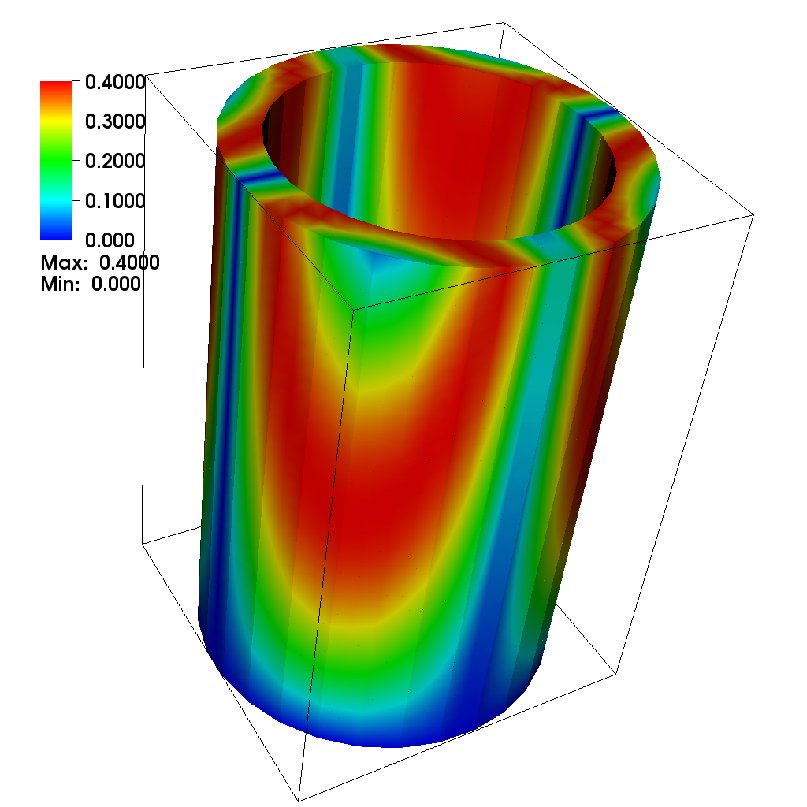 PDE-constrained optimization problems, and the development of preconditioned iterative methods for the efficient solution of the arising matrix system, is a field of numerical analysis that has recently been attracting much attention. In this paper, we analyze and develop preconditioners for matrix systems that arise from the optimal control of reaction-diffusion equations, which themselves result from chemical processes. Important aspects in our solvers are saddle point theory, mass matrix representation and effective Schur complement approximation, as well as the outer (Newton) iteration to take account of the nonlinearity of the underlying PDEs.This years second meeting of the GAMM activity group on "Dynamics and Control" will take place together with the GMA activity groups 1.30 and 1.40 as usual on a bi-anual basis. The meeting is scheduled September 17 to 21 at Sporthotel Anif near Salzburg. The talks of the GAMM activity group will take place on Wednesday 19th and contain contributions by Patrick Kürschner, Jens Saak and M. Monir Uddin. Also Matthias Voigt is participating as member of the activity group.
 Heiko Weichelt will present his latest results on the annual meeting of the Deutschen Mathematiker Vereinigung that takes place in Saarbrücken, Germany, from 17th til 20th of September 2012.Peter Benner, Jens Saak und Martin Stoll are visiting the kick-off meeting of GAMM activity group Computational Science and Engineering (CSE) in Garching on September 17th and 18th.
 Patrick Kürschner will present some of his research results at the 3rd IMA Conference on Numerical Linear Algebra and Optimisation which takes place in Birminham, UK, from 10th until 12th of September 2012.From September 2nd to 5th the 12th GAMM Workshop on Applied and Numerical Linear Algebra is taking place on Chateau Liblice in Czech Republic. The CSC group will give talks by Jens Saak, Kapil Ahuja, and Heiko Weichelt.
 The slides of the talks and the group photo taken on the balkony are now available following the link above. Workshop patricipants may request user and password for access to the archive from the research group members.
 The Linux cluster The CSC group welcomes two new team members. Martin Redmann joined us as a PhD student working on the interface of model order reduction and stochastics. Dr. Piotr Skrzypacz joined the CSC group as a Postdoc for the remainder of this year. John Pearson (University of Oxford) will be coming to Magdeburg in September and October of 2012. He will be working with Martin Stoll on the fast solution
of optimal control problems coming from the modelling of chemical processes. His research visit is kindly funded by the ESF OPTPDE program. This visit
is part of an ongoing project between Oxford and Magdeburg.This paper presents the results obtained within the SPP1253 project: Optimal Control-Based Feedback Stabilization in Multi-Field Flow Problems .
The Linux cluster The CSC group welcomes two new team members. Martin Redmann joined us as a PhD student working on the interface of model order reduction and stochastics. Dr. Piotr Skrzypacz joined the CSC group as a Postdoc for the remainder of this year. John Pearson (University of Oxford) will be coming to Magdeburg in September and October of 2012. He will be working with Martin Stoll on the fast solution
of optimal control problems coming from the modelling of chemical processes. His research visit is kindly funded by the ESF OPTPDE program. This visit
is part of an ongoing project between Oxford and Magdeburg.This paper presents the results obtained within the SPP1253 project: Optimal Control-Based Feedback Stabilization in Multi-Field Flow Problems . Dr. Vasile Sima from the National Institute for Research & Development in Informatics, Bucharest, Romania, visits CSC in the period June 18 - July 20, 2012.
 From June 18th to 22nd the SIAM Applied Linear Algebra conference 2012 is taking place in Valencia (Spain). The Computational Methods in Systems and Control Theory group is organizing two Minisymposia (Jens Saak and Martin Stoll) there. Moreover the group presents five invited Minisymposium talks (Peter Benner, Kapil Ahuja, Tobias Breiten, Jens Saak and Martin Stoll), as well as three contributed talks (Martin Hess, Patrick Kürschner und M. Sahadet Hossain) in several sections.One Postdoctoral Research Associate in Numerical Analysis working with Dr. Martin
Stoll within the Computational Methods in Systems and Control Theory group. Our
goal is the fast solution of large-scale optimization problems subject to a partial
differential equation (PDE) or systems of PDEs with possibly additional algebraic
or box constraints. This news entry is expired.One Postdoctoral Research Associate in Numerical Analysis working with Prof. Peter Benner
within the Computational Methods in Systems and Control Theory group. The research focus in this project is on developing novel model order reduction
techniques for nonlinear systems. This news entry is expired.One Senior Postdoctoral Research Associate in Numerical Analysis working with Prof. Peter Benner
within the Computational Methods in Systems and Control Theory group. The
candidate is expected to develop computational methods for UQ in applications
arising in process engineering, systems biology, biotechnology, and other areas of
science and engineering with a focus on the research fields at the MPI MD. This news entry is expired.extension and maintenance of the research groups web site. Contact: Jens Saak. This news entry is expired.The workshop will be held at Schloss Ringberg. The program including abstracts of the presentations can be downloaded here.
From June 18th to 22nd the SIAM Applied Linear Algebra conference 2012 is taking place in Valencia (Spain). The Computational Methods in Systems and Control Theory group is organizing two Minisymposia (Jens Saak and Martin Stoll) there. Moreover the group presents five invited Minisymposium talks (Peter Benner, Kapil Ahuja, Tobias Breiten, Jens Saak and Martin Stoll), as well as three contributed talks (Martin Hess, Patrick Kürschner und M. Sahadet Hossain) in several sections.One Postdoctoral Research Associate in Numerical Analysis working with Dr. Martin
Stoll within the Computational Methods in Systems and Control Theory group. Our
goal is the fast solution of large-scale optimization problems subject to a partial
differential equation (PDE) or systems of PDEs with possibly additional algebraic
or box constraints. This news entry is expired.One Postdoctoral Research Associate in Numerical Analysis working with Prof. Peter Benner
within the Computational Methods in Systems and Control Theory group. The research focus in this project is on developing novel model order reduction
techniques for nonlinear systems. This news entry is expired.One Senior Postdoctoral Research Associate in Numerical Analysis working with Prof. Peter Benner
within the Computational Methods in Systems and Control Theory group. The
candidate is expected to develop computational methods for UQ in applications
arising in process engineering, systems biology, biotechnology, and other areas of
science and engineering with a focus on the research fields at the MPI MD. This news entry is expired.extension and maintenance of the research groups web site. Contact: Jens Saak. This news entry is expired.The workshop will be held at Schloss Ringberg. The program including abstracts of the presentations can be downloaded here. Nick Higham from the University of Manchester will be visiting the CSC group from the 25th of April. Nick will give a presentation as part of the MPI
colloquium series joint with the Department of Mathematics colloquium series. The title of his presentation is Recent Progress in Matrix Functions and the talk will be given on Thursday, April 26, 2012 at 5 pm here at the MPI.
Nick is the Richardson Professor of Applied Mathematics and an expert on many things in Numerical Analysis with a particular focus on Numerical Linear Algebra as well as Numerical Software. He is the vice president
of SIAM, a fellow of the Royal Society and SIAM fellow.Jan Heiland from TU Berlin will be visiting the CSC group. He will give a presentation titled Differential-algebraic Riccati Decoupling in Optimal Control of Flows in the CSC Reading Group. Main reason for the visit is a projected collaboration with Jens Saak, Norman Lang and Heiko Weichelt.
Nick Higham from the University of Manchester will be visiting the CSC group from the 25th of April. Nick will give a presentation as part of the MPI
colloquium series joint with the Department of Mathematics colloquium series. The title of his presentation is Recent Progress in Matrix Functions and the talk will be given on Thursday, April 26, 2012 at 5 pm here at the MPI.
Nick is the Richardson Professor of Applied Mathematics and an expert on many things in Numerical Analysis with a particular focus on Numerical Linear Algebra as well as Numerical Software. He is the vice president
of SIAM, a fellow of the Royal Society and SIAM fellow.Jan Heiland from TU Berlin will be visiting the CSC group. He will give a presentation titled Differential-algebraic Riccati Decoupling in Optimal Control of Flows in the CSC Reading Group. Main reason for the visit is a projected collaboration with Jens Saak, Norman Lang and Heiko Weichelt.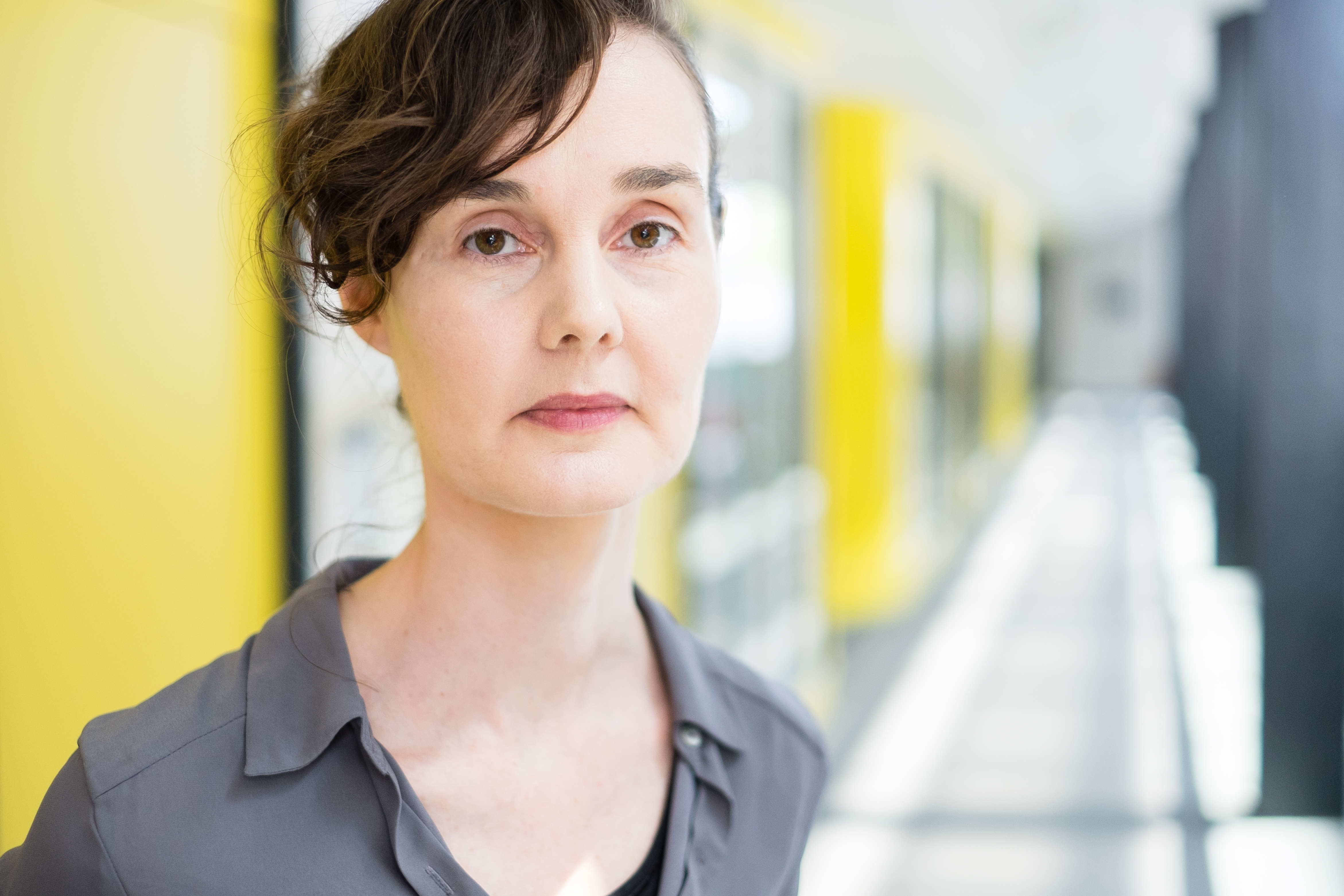 Catherine Powell from the University of Manchester will be visiting the CSC group after Easter. She will give a presentation titled Efficient solvers for saddle point problems with random data on Tuesday the 10th of April at 2pm. Catherine is an expert on Uncertainty Quantification with a particular
focus on computational fluid dynamics.Starting from May, three interns will visit CSC for two to three months. Kumod Ranjan (National Institute of Technology, Warangal (India)) who got a DAAD WISE scholarship will assist Jens Saak with his work. Furthermore, Peihong Jiang (University of Rochester (USA)) who
received a grant from the DAAD RISE program and Maximilian Bremer (University of Texas at Austin (USA)) will join Matthias Voigt.Also this year our group contributes to the GAMM Annual Meeting.
Martin Stoll and Matthias Voigt participate in organizing two
Minisymposia. The both and Tobias Breiten, Sara Grundel, Martin Heß,
Patrick Kürschner, Thomas Mach, and Jens Saak give talks at the GAMM Annual Meeting
2012 in Darmstadt.
Catherine Powell from the University of Manchester will be visiting the CSC group after Easter. She will give a presentation titled Efficient solvers for saddle point problems with random data on Tuesday the 10th of April at 2pm. Catherine is an expert on Uncertainty Quantification with a particular
focus on computational fluid dynamics.Starting from May, three interns will visit CSC for two to three months. Kumod Ranjan (National Institute of Technology, Warangal (India)) who got a DAAD WISE scholarship will assist Jens Saak with his work. Furthermore, Peihong Jiang (University of Rochester (USA)) who
received a grant from the DAAD RISE program and Maximilian Bremer (University of Texas at Austin (USA)) will join Matthias Voigt.Also this year our group contributes to the GAMM Annual Meeting.
Martin Stoll and Matthias Voigt participate in organizing two
Minisymposia. The both and Tobias Breiten, Sara Grundel, Martin Heß,
Patrick Kürschner, Thomas Mach, and Jens Saak give talks at the GAMM Annual Meeting
2012 in Darmstadt. The 12th Copper Mountain Confernce on Iterative Methods will take place from 25th till 30th March 2012. Heiko Weichelt will present the latest results about Efficient Solution of Large-Scale Saddle Point Systems
Arising in Feedback Control of the Stokes Equations there.
The 12th Copper Mountain Confernce on Iterative Methods will take place from 25th till 30th March 2012. Heiko Weichelt will present the latest results about Efficient Solution of Large-Scale Saddle Point Systems
Arising in Feedback Control of the Stokes Equations there. Elisabeth Ullmann (University of Bath) is visiting us this week. She gives a seminar talk on Numerical Methods for PDEs with Uncertainties (21/03/11, 14:00).
 This paper presents the results obtained within the FVV pilot study concerning model order reduction for EMBS.Heiko Weichelt presented his latest results about Riccati-Based Boundary Feedback Stabilization of Incompressible Flow Problems at the OCIP2012 in Garching by Munich (Germany).
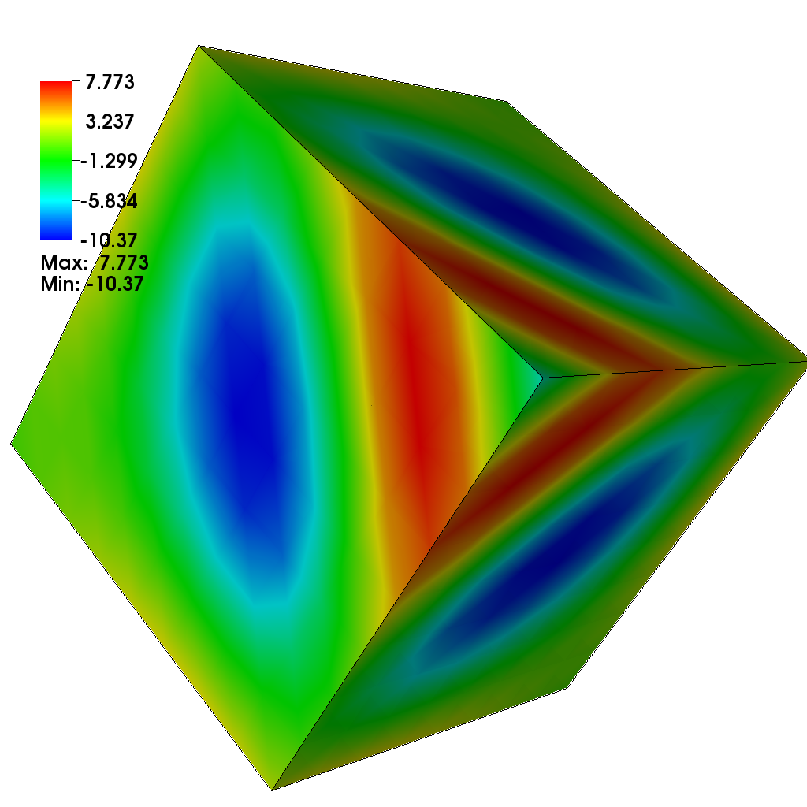 In this paper we consider a PDE-constrained optimization problem where an H1 regularization control term is introduced. We address both time-independent and time-dependent versions. We introduce bound constraints on the state, and show how these can be handled by a Moreau-Yosida penalty function. We propose Krylov solvers and preconditioners for the different problems and illustrate their performance with numerical examples.In March Kapil Ahuja, who received a PhD from Virgina Tech (Blacksburg) last year, is new in the CSC group.We investigate the application of the LR Cholesky algorithm to symmetric hierarchical matrices. The data-sparsity of these matrices make the otherwise expensive LR Cholesky algorithm applicable, as long as the data-sparsity is preserved. We will see that the data-sparsity of hierarchical matrices is not well preserved.Kalman-Yakubovich-Popov Lemma for Algebraic Difference EquationsNumerical Computation of Generalized Structured PseudospectraModel reduction in complex biochemical networksOptimal Control of a second order partial differential
equation with acceleration measurements. Optimal control problems for
infinite dimensional second order systems with acceleration measurements are
in general ill-posed. Jacob and Morris proposed a method exploiting the actual
implementation of the measurement that pulls the problem back to a well posed
one. Here such a system is to be implemented and solved
numerically.Numerical solution of low-rank representations of band-limited GramiansSimultaneous iterative solution of the adjoint linear systems in the dual low-rank ADI iteration for Lyapunov equationsBart Vandereycken is visiting from EPFL from the 16th to the 20th of January. Bart will give a talk titled "Riemannian algorithms for rank-structured matrices and tensors" on Tuesday at 2pm. Please come along. Bart is the recipient of the 2011 Householder prize, which is awarded only every 3 years. He is an expert on optimization on manifolds and matrix equations.
In this paper we consider a PDE-constrained optimization problem where an H1 regularization control term is introduced. We address both time-independent and time-dependent versions. We introduce bound constraints on the state, and show how these can be handled by a Moreau-Yosida penalty function. We propose Krylov solvers and preconditioners for the different problems and illustrate their performance with numerical examples.In March Kapil Ahuja, who received a PhD from Virgina Tech (Blacksburg) last year, is new in the CSC group.We investigate the application of the LR Cholesky algorithm to symmetric hierarchical matrices. The data-sparsity of these matrices make the otherwise expensive LR Cholesky algorithm applicable, as long as the data-sparsity is preserved. We will see that the data-sparsity of hierarchical matrices is not well preserved.Kalman-Yakubovich-Popov Lemma for Algebraic Difference EquationsNumerical Computation of Generalized Structured PseudospectraModel reduction in complex biochemical networksOptimal Control of a second order partial differential
equation with acceleration measurements. Optimal control problems for
infinite dimensional second order systems with acceleration measurements are
in general ill-posed. Jacob and Morris proposed a method exploiting the actual
implementation of the measurement that pulls the problem back to a well posed
one. Here such a system is to be implemented and solved
numerically.Numerical solution of low-rank representations of band-limited GramiansSimultaneous iterative solution of the adjoint linear systems in the dual low-rank ADI iteration for Lyapunov equationsBart Vandereycken is visiting from EPFL from the 16th to the 20th of January. Bart will give a talk titled "Riemannian algorithms for rank-structured matrices and tensors" on Tuesday at 2pm. Please come along. Bart is the recipient of the 2011 Householder prize, which is awarded only every 3 years. He is an expert on optimization on manifolds and matrix equations. Hermann Mena (ENP Quito, Ecuador) is visiting the MPI Magdeburg again for three weeks.
 Michael Saunders is visiting the CSC group from Stanford. He will give a presentation on Thursday at 2pm at the MPI titled "CG and MINRES: A tale of two solvers". Michael is an expert on numerical optimization and numerical linear algebra among other things. He is an ISI highly cited researcher in both mathematics and computer science. He will arrive on Wednesday and stay until Sunday.In January Akwum Onwunta started as PhD-student in the CSC group.
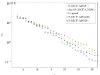 Peter Benner, Patrick Kürschner and Jens Saak have published the first preprint in 2012 in the MPIMD preprint series. The preprint is entitled "A Goal-Oriented Dual LRCF-ADI for Balanced Truncation".
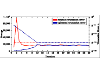 The CSC group published 3 new preprints in the last 5 days:
  This workshop is the fourth in a series of workshops on matrix equations held previously in Leipzig 2005, Chemnitz 2007, and Braunschweig 2009. The workshops are organized by Peter Benner (MPI Magdeburg), Heike Fassbender (TU Braunschweig), Lars Grasedyck (RWTH Aachen), and Daniel Kressner (EPF Lausanne).John Pearson is visiting the CSC group from the 14th to the 18th of November. He is giving a seminar titled Preconditioned Iterative Methods for Optimal Control Problems on Thursday the 17th at 3pm. He will also be working with Martin Stoll on the fast solution of nonlinear optimal control problems.
  Philip Losse defended his dissertation on The ℋ∞ Optimal Control Problem for Descriptor Systems on Friday, 4th November. He will receive his degree from TU Chemnitz.Cosmin Ionita from Rice University, Houston is visiting the CSC group. He will give a seminar talk on November 24th.
 The Summer School Numerical Linear Algebra for Dynamical and High-Dimensional Systems will be held on October 10-15, 2011 in Trogir, Croatia and is organized by Peter Benner (MPI Magdeburg), Daniel Kressner (EPF Lausanne), Ninoslav Truhar (University of Osijek) and Zlatko Drmač (University of Zagreb).On October 4th and 5th all members of the DFG Transregio SFB 96
Thermo-energetic design of machine tools meet at TU Dresden for their first general assembly. During the 2 days workshop the 19 participating subprojects present their current and future work for the first year of existence. Peter Benner, Norman Lang and Jens Saak will join as responsible for project A06 Model Order Reduction for Thermo-Elastic Assembly Group Models and establish contacts to the persons in charge of the other simulation projects.In October Sara Grundel, who received a PhD from the Courant Institute (New York) in May, and Norman Lang (joining the Chemnitz part) are new in the CSC group.The anual meeting of the DFG SPP1253 Optimization with Partial Differential Equations will be held at Banz monastery. Peter Benner, Heiko Weichelt and Jens Saak will participate and present the latest results of the local project Optimal Control-Based Feedback Stabilization in Multi-Field Flow Problems there. (Talk)The GAMM Workshop 2011 on Applied and Numerical Linear Algebra with Special Emphasis on Model Reduction will be held in Bremen on 22 and 23 September 2011. Peter Benner is member of the organizing committee. Tobias Breiten, Patrick Kürschner, Thomas Mach, Jens Saak, and André Schneider present their work in contributed talks. The workshop is followed by a special colloquium celebrating the 60th birthday of Angelika Bunse-Gerstner.In September Mohammed Sahadet Hossain, who recently finished his PhD in Chemnitz, and the PhD-students Yongjin Zhang and Jonas Denißen are new in the CSC group.
The Summer School Numerical Linear Algebra for Dynamical and High-Dimensional Systems will be held on October 10-15, 2011 in Trogir, Croatia and is organized by Peter Benner (MPI Magdeburg), Daniel Kressner (EPF Lausanne), Ninoslav Truhar (University of Osijek) and Zlatko Drmač (University of Zagreb).On October 4th and 5th all members of the DFG Transregio SFB 96
Thermo-energetic design of machine tools meet at TU Dresden for their first general assembly. During the 2 days workshop the 19 participating subprojects present their current and future work for the first year of existence. Peter Benner, Norman Lang and Jens Saak will join as responsible for project A06 Model Order Reduction for Thermo-Elastic Assembly Group Models and establish contacts to the persons in charge of the other simulation projects.In October Sara Grundel, who received a PhD from the Courant Institute (New York) in May, and Norman Lang (joining the Chemnitz part) are new in the CSC group.The anual meeting of the DFG SPP1253 Optimization with Partial Differential Equations will be held at Banz monastery. Peter Benner, Heiko Weichelt and Jens Saak will participate and present the latest results of the local project Optimal Control-Based Feedback Stabilization in Multi-Field Flow Problems there. (Talk)The GAMM Workshop 2011 on Applied and Numerical Linear Algebra with Special Emphasis on Model Reduction will be held in Bremen on 22 and 23 September 2011. Peter Benner is member of the organizing committee. Tobias Breiten, Patrick Kürschner, Thomas Mach, Jens Saak, and André Schneider present their work in contributed talks. The workshop is followed by a special colloquium celebrating the 60th birthday of Angelika Bunse-Gerstner.In September Mohammed Sahadet Hossain, who recently finished his PhD in Chemnitz, and the PhD-students Yongjin Zhang and Jonas Denißen are new in the CSC group.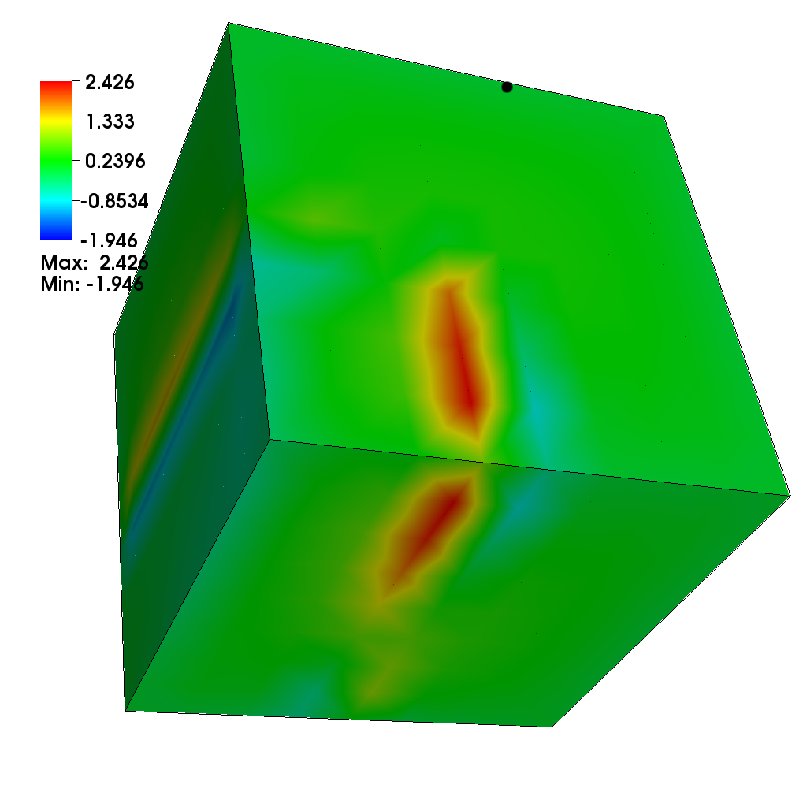 In this article, we motivate, derive and test effective preconditioners to be used with the minres algorithm for solving a number of saddle point systems, which arise in PDE constrained optimization problems. We consider the distributed control problem involving the heat equation with two different functionals, and the Neumann boundary control problem involving Poisson equation and the heat equation. Crucial to the effectiveness of our preconditioners in each case is an effective approximation of the Schur complement of the matrix system. In each case, we state the problem being solved, propose the preconditioning approach, prove relevant eigenvalue bounds, and provide numerical results which demonstrate that our solvers are effective for a wide range of regularization parameter values, as well as mesh sizes and time-steps.
 The 17th ILAS Conference will be held in Braunschweig from 22 to 26 august 2011. Peter Benner is member of the organizing committee. Jens Saak and Alfredo Remón Gómez (Universitat Jaume I, Castelló de la Plana) are organizing an YR minisymposium on Parallel Computing in Numerical Linear Algebra. Further several group members will give contributed talks.
 Since August Mohammad Monir Uddin is PhD-student of the CSC group.Fikriye Yilmaz from Gazi University in Ankara is visiting the CSC group. She is going to work with Martin Stoll on optimal control problems for PDEs and is giving a presentation in the CSC seminar on Wednesday at 11 am. The title for her talk is "All-at-once solution of optimal control for Burgers equation"
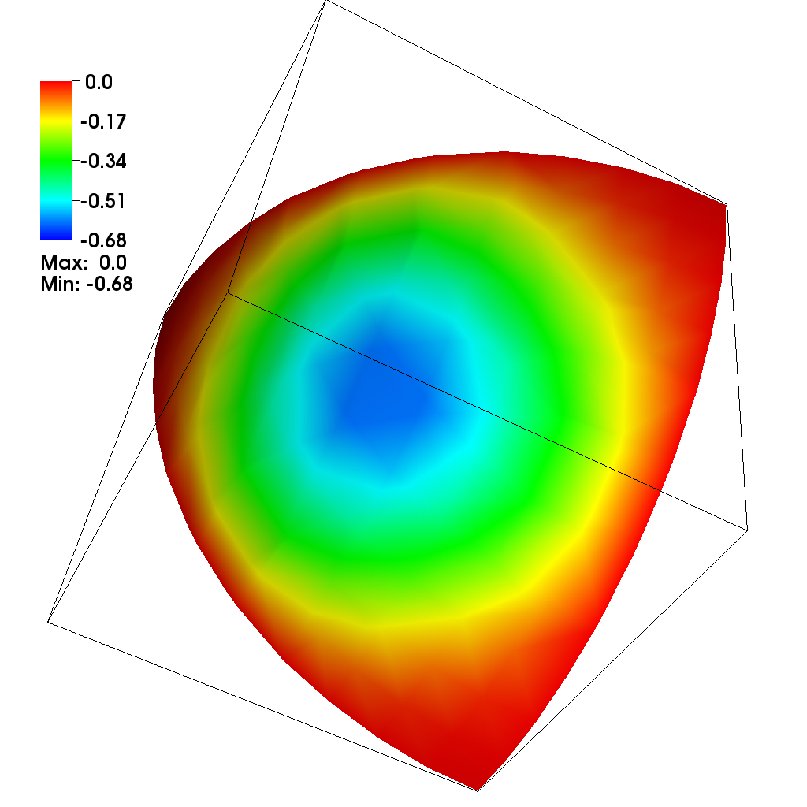 In this paper we describe the efficient solution of a PDE-constrained optimization problem subject to the time-periodic heat equation. We propose a space-time formulation for which we develop a monolithic solver. We present preconditioners well suited to approximate the Schur-complement of the saddle point system associated with the first order conditions. This means that in addition to a Richardson iteration based preconditioner we also introduce a preconditioner based on the tensor product structure of the PDE discretization, which allows the use of a FFT based preconditioner. We also consider additional bound constraints that can be treated using a semi-smooth Newton method. Moreover, we introduce robust preconditioners with respect to the regularization parameter. Numerical results will illustrate the competitiveness and flexibility of our approach.
 Regulator based tracking control of a parabolic partial
differential equation under control constraintsextension and maintenance of the research groups web site. Contact: Jens Saak. This news entry is expired.
Regulator based tracking control of a parabolic partial
differential equation under control constraintsextension and maintenance of the research groups web site. Contact: Jens Saak. This news entry is expired. Further development of the software library M.E.S.S. Contact: Martin Köhler. This news entry is expired.
 Model reduction is a crucial and important technique in many applications such as chemical or mechanical engineering. Important contributions have been made over the last decades and today much of the research is devoted to developing techniques for generating reduced order models for parameter dependent problems. The Computational Methods in Systems and Control Theory group at the MPI Magdeburg and the RWTH Aachen (research groups of Martin Grepl and Karen Veroy-Grepl) are joining forces for a day, 5th of July 2011, to discuss the latest developments and state-of-the art methods to generate accurate and efficient reduced models for problems coming from a variety of applications. The workshop is going to be held in our big seminar room and we invite you to join us for the whole day or parts of it.Deutsche Forschungs Gemeinschaft (DFG) sets up new Transregio SFB 96 Thermo-Energetic Design of Machine Tools at Technical Universities Dresden and Chemnitz, as well as RWTH Aachen. The Chemnitz part of our research group is participating with project A06 Model Order Reduction for thermo-elastic assembly group models.For the research project "Model Order Reduction for Thermo-Elastic Assembly Group Models" we have an open full researcher position following group 13 in TV-L in the Chemnitz part of our group. Please find details in the job posting at Chemnitz UT math faculty. Applications due July 8th 2011. This news entry is expired.Dr. Vasile Sima from the National Institute for Research & Development in Informatics, Bucharest, Romania, will visit CSC in the period June 27 - July 26, 2011.
 The main topic of the proposed dissertation is to develop and implement efficient iterative solvers for the numerical solution of Cahn-Hilliard problems. Please note that the description is in German but if you
are interested anyway, please contact Martin Stoll (stollm@mpi...) for more details. This topic is already taken but similar ones can be offered for interested students. This news entry is expired.
The main topic of the proposed dissertation is to develop and implement efficient iterative solvers for the numerical solution of Cahn-Hilliard problems. Please note that the description is in German but if you
are interested anyway, please contact Martin Stoll (stollm@mpi...) for more details. This topic is already taken but similar ones can be offered for interested students. This news entry is expired. Peter Benner and Martin Stoll will participate in the Householder Symposium XVIII on Numerical Linear Algebra to be held on June 12-17, 2011, at the Granlibakken Conference Center & Lodge in Tahoe City, California. In his plenary lecture Peter Benner will talk about Rational Krylov Subspaces for Nonlinear Model Reduction. Martin Stoll will present a poster on Preconditioning for time-dependent optimal control problems.
 Peter Benner is member of the organizing committee for a 1-day symposium on Eigenvalues, Model Order Reduction and Trust Regions in celebration of Danny Sorensen's 65th birthday. The symposium will be held in Reno, Nevada.We discuss the problem of ℋ₂-model order reduction of bilinear control systems. We revisit existing first order necessary conditions for ℋ₂-optimality based on the solutions of generalized Lyapunov equations arising in bilinear system theory and present an iterative algorithm which, upon convergence, yields a reduced system fulfilling these conditions. We further establish a connection to another method based on generalized rational interpolation leading to an adaption of the successful iterative rational Krylov algorithm (IRKA) to bilinear systems.
 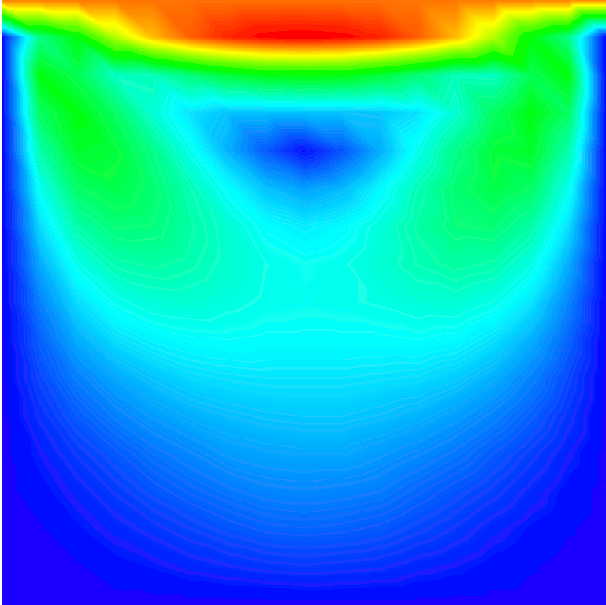 The solution of time-dependent PDE-constrained optimization problems subject to unsteady flow equations presents a challenge to both algorithms and computers. In this paper we present an all-at-once approach where we solve for all time-steps of the discretized unsteady Stokes problem at once. The most desirable feature of this approach is that for all steps of an iterative scheme we only need approximate solutions of the discretized Stokes operator. This leads to an efficient scheme which exhibits mesh-independent behaviour.Test sequence for the verification of a MATLAB/Fortran function implementation. Contact: Matthias Voigt, more informations (german only). This news entry is expired.
 Saturday, 28th May 2011, 6.00 a.m. to 1.00 p.m., Max Planck Institute MagdeburgNewsropa.de have an article on our new Linux-cluster otto. Further the Volksstimme have an article in their print-version on otto.The registration for the Summer School Numerical Linear Algebra for Dynamical and High-Dimensional Systems is now open until June 30. The school will be held on October 10-15, 2011 in Trogir, Croatia and is organized by Peter Benner (MPI Magdeburg), Daniel Kressner (EPF Lausanne), Ninoslav Truhar (University of Osijek) and Zlatko Drmač (University of Zagreb).
 Roland Herzog (TU Chemnitz) and Martin Stoll are organizing a minisymposium on Preconditioning in PDE-Constrained Optimization at the SIAM Conference on Optimization, which takes place from May 16 until May 19, 2011, in Darmstadt. Peter Benner gives a talk in the minisymposium Model Order Reduction Techniques in PDE Constrained Optimization on System-theoretic Methods for Model Reduction of Linear and Nonlinear Parabolic Systems, too.Daniel Kressner (EPF Lausanne) is visiting us 11th to 13th of May. He will talk about Low-rank tensor techniques for parametrized and high-dimensional linear algebra problems in the MPI Colloquium on the 12th of May. Daniel is an expert on many things in numerical linear algebra such as tensor techniques and eigenvalue problems.
 David Knezevic (MIT) will be visiting us from the 9th to the 11th of May. David is an expert on the analysis and implementation of the Certified Reduced Basis Method. He is one of the developers of the finite element package libmesh. His PhD at Oxford was on the numerical simulation of dilute polymeric fluids. David gives a seminar talk on The Certified Reduced Basis Method: Real-time Simulation of Parametrized Systems (05/09/11, 15:30).
 Friday, May 6th, 2011, 9.00 a.m. to 1.00 p.m., Max Planck Institute Magdeburg We would like to discuss with you how to enhance cooperation between fundamental research and industrial application, looking at projects which are being pursued jointly between research groups of the Max Planck Institute Magdeburg and external partners from industry. Invitation and program (in German) ...Melina Freitag (University of Bath) will be visiting us in the first week of May (02-06). Melina is an expert on eigenvalue problems and their numerical solution with a particular focus on preconditioned inverse iteration. She has also worked extensively on inverse problems in weather forecasting in collaboration with the Met Office. Melina gives an seminar talk on Preconditioned inverse iteration and shift-invert Arnoldi method (05/03/11, 15:00).
 Jens Saak is invited to J. J. Strossmayer University of Osijek to give a lecture on Algebraic Riccati Equations from May 2 to 06. Additionally he give a colloquiums talk at 5th May on Numerical Solution of Linear Quadratic Regulator Problems under PDE Constraints.
 Tobias Breiten, Patrick Kürschner, Thomas Mach and Matthias Voigt give contributed talks at the GAMM Annual Meeting 2011 at TU Graz.Hermann Mena (ENP Quito, Ecuador) is visiting the MPI Magdeburg again for two weeks.
 CSC research group met the first time for a research group weekend workshop in Clausthal Zellerfeld in the Harz Mountains from April 7th to April 11th. Besides 14 discussion forums about problems of the recent group research a visit in a local glass factory, a BBQ, a hike, a campfire, and sports (Bildungsstätte der Sportjugend Niedersachsen) was scheduled.
 Timo Reis from TU Berlin/TU Hamburg-Harburg is visiting CSC in the period from March 21st to March 25th. Reason for his visit is ongoing work in the area of model order reduction together with André Schneider. He will give a CSC seminar talk about Infinite-Dimensional Systems and Balanced Truncation on March 23th, 10:00 (V1.06).The preconditioned inverse iteration is an efficient method to compute the smallest eigenpair of a symmetric positive definite matrix ℋ. Here we use this method to find the smallest eigenvalues of a hierarchical matrix. We use ℋ-arithmetic to precondition with an approximate inverse of M or an approximate Cholesky decomposition of M. In general ℋ-arithmetic is of linear-polylogarithmic complexity, so the computation of one eigenvalue is cheap.
 The Otto von Guericke University Magdeburg has recently announced that they have granted Peter Benner the title of Honorary Professor in Mathematics. Press release (in German) ...
 Hermann Mena (ENP Quito, Ecuador) is visiting the MPI Magdeburg again. Together with René Schneider (TU Chemitz) we will continue the cooperation in the project aerial-spray-drift.
 Group member Judith Schneider (sub project 3 within the MoreSim4Nano research network) and André Bodendiek (sp 1, TU Braunschweig) visit partners of sp 2 at TU Darmstadt on 3rd of February. Furthermore, the new project webpages are available now.
 Peter Benner, Martin Heß, Jens Saak, Judith Schneider und André Schneider join the Workshop on Model Order Reduction in Optimization and Control with PDEs from 26th to 28th January 2011 at WIAS in Berlin.
 At the beginning of the year Judith Schneider, Martin Heß and Martin Köhler are new members of the CSC group. Additionally Patrick Kürschner and André Schneider move from Chemnitz to Magdeburg.
 Am 21. Dezember 2010, 14:00 Uhr, verteidigt Heiko Weichelt seine Diplomarbeit mit dem Titel Feedback-Stabilisierung von instationären, inkompressiblen Strömungen mit Riccati-Ansatz in Chemnitz im Raum 2/B202.Am 15. Dezember 2010, 16:00 Uhr, verteidigt Martin Köhler seine Diplomarbeit mit dem Titel H2 Modellreduktion Verfahren-Implementierung-Vergleich in Chemnitz im Raum 2/41/638.We use a bisection method to compute the eigenvalues of a symmetric ℋℓ-matrix M. The bisection method requires matrix-size independent many iterations to find an eigenvalue up to the desired accuracy, so that an eigenvalue can be found in linear-polylogarithmic time. Numerical experiments demonstrate the efficiency of the algorithm, in particular for the case where some interior eigenvalues are required.
 The new Group Webpage is almost complete. We have copied large parts of the old MiIT-Webpage, neverless some parts are still under construction. If you do not find the informations you search, do not hesitate to ask us!
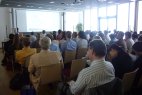 The colloquium is dedicated to our new director Prof. Peter Benner. We continue the colloquium on Friday with mathematical talks presenting selected topics of Peter Benner's research group.
 As of September 1, 2010, Peter Benner has taken up his position as a director at the Max-Planck-Institute for Dynamics of Complex Technical Systems in Magdeburg full-time. At MPI Magdeburg, he leads the group Computational Methods in Systems and Control Theory (CSC). Additionally, he will also keep the "Mathematics in Industry and Technology" professorship in Chemnitz on an extraofficial basis.
 Development and implementation of a Multigrid-ADI method for solving Lyapunov equationsComputation of Lyapunov exponents for dynamical systemsDevelopment and comparison of model reduction methods for concrete applications (several topics, possibility to work in a group)